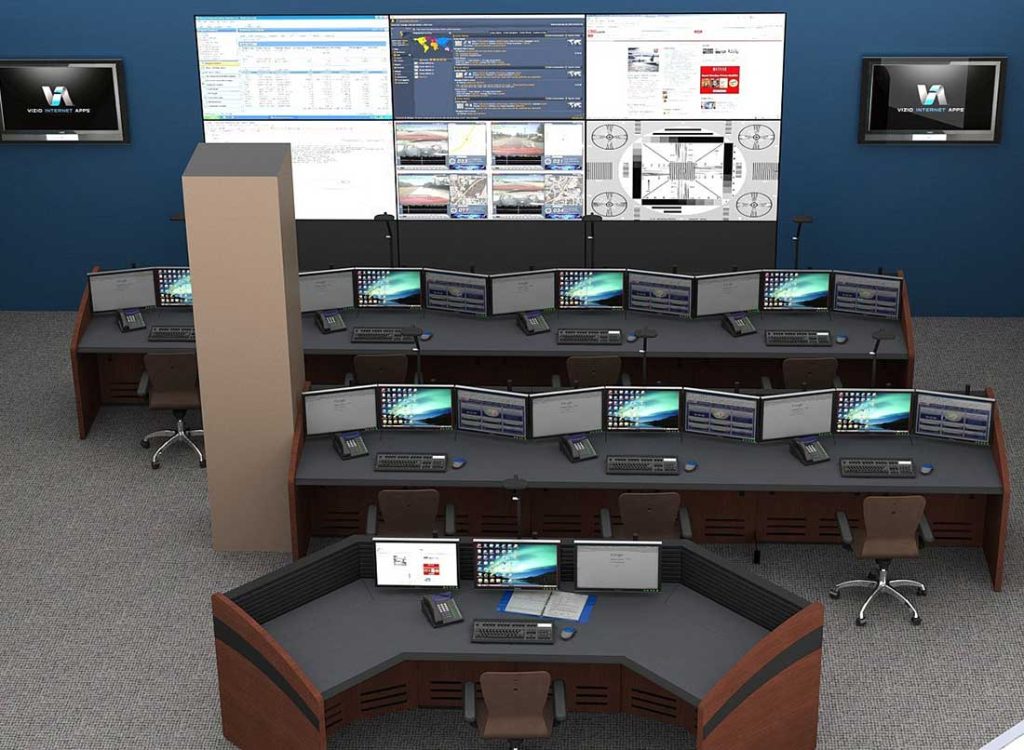
Emergency Operations Center (EOC) Design: Planning, Layout, and Infrastructure for Effective Crisis Response

Jump to a Section
TL;DR – Quick Summary
- Topic Overview: Emergency Operations Centers (EOCs) serve as centralized command hubs during crises, enabling coordinated decision-making, resource allocation, and communication across agencies, departments, and stakeholders.
- Key Insights: Effective EOC design goes beyond policy and planning—it requires intentional layout, resilient infrastructure, integrated technology, and purpose-built control room furniture that supports continuous operations, clear situational awareness, and rapid response under pressure.
- Who This Is For: Emergency managers, public-sector leaders, facility planners, and private organizations responsible for crisis response, business continuity, or coordination with public emergency services.
- Action Step: Evaluate your current or planned EOC against FEMA and NIMS guidance, assess whether your physical or virtual setup supports sustained operations, and ensure your space, technology, and workstations are designed for real-world emergency conditions—not just occasional use.
In large-scale emergencies—natural disasters, infrastructure failures, public safety incidents, or security threats—organizations rely on structured command environments to coordinate response efforts, maintain situational awareness, and make time-sensitive decisions.
The Emergency Operations Center (EOC) serves as the central coordination hub during these events, bringing together leadership, operational teams, and external agencies in a single command environment.
While emergency management frameworks such as FEMA’s National Incident Management System (NIMS) and the Incident Command System (ICS) define how response activities are organized, the effectiveness of an EOC ultimately depends on how well the space itself is designed.
Poor layout, inadequate technology integration, or furniture not suited for sustained operations can undermine decision-making during the moments when clarity and coordination matter most.
Modern EOC planning must therefore address not only policies and procedures, but also physical design, console infrastructure, display systems, and operator ergonomics that support continuous, high-pressure operations.
The Role of the Emergency Operations Center
An Emergency Operations Center control room functions as the strategic command environment for managing incidents that exceed routine operational capacity. While on-scene responders focus on tactical execution—fire suppression, medical response, law enforcement, or infrastructure repair—the EOC supports:
- Incident coordination and resource allocation
- Executive decision-making and policy direction
- Interagency communication and information sharing
- Public information and crisis communications
- Business continuity and recovery planning
EOCs may be operated by government agencies, such as emergency management departments, utilities, and public safety organizations, or by private enterprises that coordinate internal response efforts and engage external stakeholders.
Depending on the organization, an EOC may be a dedicated hardened facility, a dual-use command room, or a hybrid physical/virtual environment designed to activate as needed.
Aligning EOC Operations with NIMS and ICS
National Incident Management System (NIMS), developed by FEMA, provides a standardized framework for incident response across federal, state, local, and private-sector organizations. At the core of NIMS is the Incident Command System (ICS), which defines roles, responsibilities, and communication structures during emergency events.
For EOC planners, alignment with ICS is critical—but alignment alone is not sufficient. The physical environment of the EOC must support ICS workflows, including:
- Clear command hierarchy visibility
- Defined zones for operations, planning, logistics, and command staff
- Rapid information flow between functional roles
- Secure communication channels for classified or sensitive information
An EOC designed without consideration for these operational relationships can introduce friction, slow coordination, and create confusion during high-stress events.
Physical vs. Virtual EOCs: Design Implications
EOCs may be established as:
- Primary physical facilities designed for continuous readiness
- Secondary or backup locations for redundancy
- Virtual or hybrid EOCs leveraging secure communications platforms
While virtual coordination is increasingly used, physical EOCs remain essential for large-scale incidents that require real-time collaboration, shared displays, and secure communications. Even hybrid models benefit from a well-designed physical core that anchors decision-making.
Key design considerations differ by model, but all EOCs must account for:
- Sustained multi-shift operations
- Technology density and cabling requirements
- Redundant power and communications
- Operator comfort and fatigue mitigation
Core Design Principles for Modern EOCs
1. Survivability and Continuity of Operations
FEMA emphasizes that an EOC must remain operational throughout an emergency. This begins with site selection—outside immediate hazard zones—and extends to building integrity, access control, and infrastructure resilience.
From a design standpoint, survivability also includes furniture and technology choices that can withstand extended use, equipment loads, and evolving operational demands without failure.
2. Console Furniture Designed for Command Environments
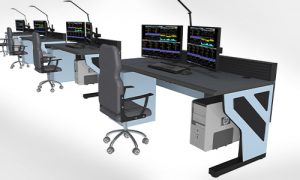
EOC operators often work extended shifts under extreme pressure. Console furniture must be purpose-built for mission-critical use—not adapted office desks.
Effective EOC consoles provide:
- Structural capacity for multiple displays, computers, and communications equipment
- Integrated cable management to maintain order and reduce failure risk
- Ergonomic positioning for seated and standing operation
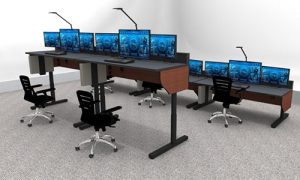
- Modular configurations that support changing team structures
Furniture selection directly impacts operator endurance, workflow efficiency, and long-term facility adaptability.
3. Display Systems and Situational Awareness
Shared visual information is central to EOC effectiveness. Monitor wall design and large-format displays enable teams to track incident status, weather data, infrastructure systems, and communications feeds simultaneously.
EOC display planning should consider:
- Viewing angles and sightlines from all operator positions
- Display redundancy and failover
- Integration with incident management software and external data sources
- Lighting control to prevent glare and eye fatigue
Display systems should be treated as operational tools, not architectural features.
4. Layout and Functional Zoning
A well-designed EOC supports multiple concurrent activities without interference. Functional zoning helps separate:
- Command and executive decision areas
- Operations and monitoring stations
- Communications and liaison positions
- Support and briefing spaces
Console layout, aisle spacing, and circulation paths must allow staff to move efficiently without disrupting critical work.
5. Accessibility, Compliance, and Human Factors
All EOCs must comply with ADA requirements and Section 508 of the Rehabilitation Act. Beyond compliance, human-centered design improves performance during prolonged operations.
Key considerations include:
- Adjustable consoles and seating for diverse users
- Acoustic control to maintain communication clarity
- Lighting tuned for 24/7 operation
- Thermal comfort supporting alertness
Design decisions that reduce physical strain also reduce cognitive fatigue during high-consequence events.
Planning for Scalability and Long-Term Use
EOCs are not static environments. Over time, organizations face:
- New threat profiles
- Expanded coordination responsibilities
- Additional agencies or departments participating
- Evolving technology requirements
Modular console systems, flexible layouts, and scalable infrastructure allow EOCs to adapt without complete redesign—protecting long-term investment and operational readiness.
Integrating Design with EOC Planning
An effective EOC plan addresses both procedures and physical execution. Planning should integrate:
- Activation criteria and staffing models
- Console and technology requirements per role
- Information flow between field operations and command staff
- Redundancy for prolonged incidents
Designing the EOC in parallel with operational planning ensures the space supports real-world workflows—not theoretical ones.
Conclusion: Designing EOCs for Real-World Emergencies
Emergency Operations Centers play a critical role in managing complex, high-impact events. While frameworks like NIMS and ICS define organizational structure, the physical design of the EOC determines how effectively those structures function under pressure.
Purpose-built console furniture, integrated display systems, ergonomic layouts, and resilient infrastructure transform EOCs from meeting rooms into true command environments capable of supporting sustained emergency response.
Organizations that treat EOC design as strategic infrastructure—rather than a facilities afterthought—are better prepared to coordinate response, protect personnel, and maintain continuity during the moments that matter most.
Contact Command Watch
For expert guidance on EOC console furniture, monitor wall integration, and emergency operations center design, contact our team to discuss your operational requirements and facility goals.
Contact Information:
(800) 346-7521
cwsales@command-watch.com
Top Resource For Operators:
Essential Guide to Control Room Furniture Perfect for teams evaluating console solutions for EOCs, NOCs, utilities, transportation hubs, and other mission-critical spaces.