Console Furniture: The Complete Buyer’s Guide for 24/7 Mission-Critical Environments
Jump to a Section
Your comprehensive resource for selecting, specifying, and implementing high-performance console systems that support operator excellence, maximize situational awareness, and deliver lasting value across decades of continuous operations.
TL;DR – Quick Summary
- What This Guide Covers: Mission-critical control rooms supporting network operations, emergency dispatch, utilities, military command, and security monitoring rely on specialized console furniture engineered for continuous 24/7 operation—not conventional office workstations.
- Why Control Room Consoles Are Different: Professional control room consoles are designed to support heavy equipment loads, complex multi-monitor configurations, structured cable management, and long-duration operator use while maintaining reliability, safety, and maintainability.
- Console Types Compared: Organizations selecting control room furniture in 2026 typically choose between enclosed console systems prioritizing equipment protection and aesthetics, open-frame modular designs emphasizing flexibility and cost efficiency, and sit-stand-enabled consoles supporting operator wellness during extended shifts.
- How to Choose the Right System: Successful control room projects begin with a clear understanding of operational workflows, technology requirements, staffing models, and future growth—avoiding furniture decisions based solely on appearance or initial purchase price.
- Key Evaluation Criteria: Critical decision factors include structural load capacity, ergonomic adjustability, cable management infrastructure, power and technology integration, modular reconfiguration capability, and long-term vendor support.
- Long-Term Value: Organizations investing in purpose-built control room consoles consistently achieve higher operator performance, lower total cost of ownership, and greater adaptability over 15–20 year service lifecycles compared to budget or office-based alternatives.
Understanding Modern Console Furniture Requirements
Control rooms have evolved dramatically from their origins as simple monitoring stations into sophisticated command environments where operators synthesize information from dozens or hundreds of sources, coordinate team responses to complex situations, and make time-critical decisions affecting public safety, infrastructure reliability, or organizational operations. This evolution has transformed furniture requirements from basic desk surfaces to engineered workstation systems that address the unique demands of continuous operations.
The distinction between control room furniture and standard office solutions extends far beyond superficial appearance. Mission-critical environments impose operational requirements that conventional furniture simply cannot meet: equipment loads ranging from 200-400 pounds per operator position, cable infrastructure supporting dozens of power and data connections, 24/7 usage patterns with multiple operators per position daily, and operational lifespans extending 15-20 years without replacement. Attempting to adapt office furniture for control room applications consistently results in premature failures, compromised operator performance, and expensive retrofits addressing problems that proper specification would have prevented.
Defining Professional Control Room Console Systems
Professional control room consoles represent purpose-built workstation platforms engineered specifically for operational environments where furniture performance directly impacts mission success. These specialized systems integrate multiple functional requirements into cohesive designs:
Structural engineering provides the load-bearing capacity and stability required to support multi-monitor arrays, computer equipment, networking hardware, and specialty devices without deflection, vibration, or mechanical failure across decades of continuous use. Heavy-gauge steel or aluminum frames, reinforced work surfaces, and professional-grade hardware ensure reliability that office furniture construction cannot match.
Ergonomic optimization addresses the unique challenges of extended-duration monitoring tasks through adjustable monitor positioning, proper work surface heights and depths, sit-stand capability in premium variants, optimized sightlines to video walls and shared displays, and reach distances supporting equipment access without awkward posturing that accumulates fatigue during 8-12 hour shifts.
Technology integration infrastructure encompasses comprehensive cable management raceways that prevent the tangled disorder that plagues improvised installations, equipment housing with proper ventilation to prevent heat-related failures, power distribution systems that provide reliable access at operator positions, and mounting provisions that accommodate diverse equipment types and sizes as technology evolves.
Operational flexibility through modular architecture allows console systems to be reconfigured, expanded, or adapted to changing mission requirements without starting from scratch—critical given that control room facilities typically remain in service far longer than the missions they originally supported, with organizational needs evolving continuously throughout facility lifespans.
Professional aesthetics appropriate for facilities hosting stakeholder visits, public tours, or high-level command functions, recognizing that control room appearance influences perceptions of organizational competence and operational readiness among both personnel and external audiences.
Why Console Quality Matters for Mission Performance
The relationship between furniture quality and operational performance might seem indirect, but extensive operational experience demonstrates clear connections. Operators working at poorly designed consoles experience progressive fatigue accumulation, reduced situational awareness, increased error rates, and declining morale—factors that directly undermine the mission effectiveness these facilities exist to provide.
Consider the cascading effects of inadequate monitor positioning. Operators forced to look up at screens mounted too high develop neck strain within hours, leading to frequent repositioning that momentarily reduces attention to the displayed information. Over extended shifts, this discomfort escalates into persistent pain that distracts from monitoring tasks. Across weeks and months, chronic ergonomic problems contribute to operator turnover, requiring training investments in replacements while losing the institutional knowledge and situational awareness that experienced personnel provide.
Similarly, poor cable management creates hazards and maintenance complications that increase costs over the life of the facility. Tangled cables increase troubleshooting time when equipment fails during operations, create trip hazards in operator work areas, and give the facility a less professional appearance during facility tours. More seriously, inadequate cable organization leads to mistakes during equipment changes—disconnected cables, damaged connectors, or configuration errors that take critical monitoring offline during moves, adds, or changes.
Strategic Advantage: Organizations that view control room furniture as operational infrastructure rather than office equipment consistently achieve better outcomes. Budget allocations reflecting this perspective—treating console systems as mission-critical investments comparable to display technology, network infrastructure, or computing platforms—enable procurement of furniture that actually supports operational requirements rather than representing compromised solutions that must be replaced prematurely or constantly adapted to work around design deficiencies.
Core Console Categories and Selection Criteria
The control room furniture market offers several distinct product categories, each optimized for different operational priorities, budget parameters, and facility requirements. Understanding these fundamental options and their appropriate applications enables informed decisions matching actual needs rather than defaulting to familiar approaches or selecting based primarily on initial cost without considering long-term implications.
Premium Enclosed Console Systems
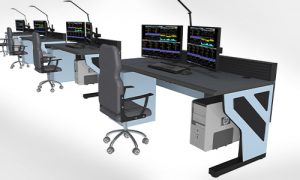
Premium enclosed consoles represent the highest tier of control room furniture, featuring complete enclosures, maximum equipment protection, comprehensive cable concealment, and refined aesthetics appropriate for high-visibility facilities. These systems typically incorporate heavy-gauge steel construction throughout, full equipment bay enclosures with doors or panels, integrated power distribution systems, professional-grade cable management, and premium surface materials selected for durability and appearance.
The primary advantages of premium enclosed systems include maximum protection of equipment from dust, physical contact, and tampering—important in facilities with public-access areas adjacent to control rooms or where classified equipment requires additional security. Complete cable concealment maintains a professional appearance during facility tours, stakeholder visits, or media coverage. Acoustic benefits from enclosed equipment cavities reduce fan noise and equipment sounds that could distract operators. The substantial construction and professional finishes signal an organizational commitment to operational excellence while providing the structural stability to support heavy equipment loads without deflection.
Enclosed consoles suit applications where these benefits justify the associated costs. Large network operations centers hosting frequent executive visits or customer tours benefit from the professional appearance and equipment security these systems provide. Military command facilities and emergency operations centers that require protection for classified equipment or serve as command posts during high-level incidents find the enclosed construction and refined aesthetics appropriate for their visibility levels. Utility control rooms and process control facilities that operate critical infrastructure often select premium consoles that reflect the mission-critical nature of operations while providing the durability required for decades of continuous use.
Open-Frame Modular Console Solutions
Open-frame console designs prioritize operational flexibility, equipment accessibility, and cost efficiency over complete enclosure and premium aesthetics. These systems feature robust structural frames—typically steel or aluminum—supporting equipment mounting, cable management, and work surfaces while leaving equipment and cabling partially visible. The open construction facilitates rapid equipment access, improves natural ventilation, reduces cooling requirements, and typically costs 30-40% less than comparable premium enclosed systems.
Open-frame consoles serve organizations prioritizing values different from those of organizations selecting premium enclosed systems. Budget-conscious agencies needing professional console functionality within constrained capital allocations find open-frame designs deliver essential capabilities at accessible price points. Facilities that experience frequent technology changes benefit from easy equipment access, which accelerates installations, modifications, and troubleshooting. Educational institutions operating training labs where students need hands-on access to equipment find open construction supports pedagogical objectives. Organizations maintaining separate equipment rooms—locating computers, servers, and networking gear away from operator positions—don’t require the enclosed equipment bays that premium consoles provide, making open-frame designs appropriate for their applications.
The cost differential between open-frame and premium enclosed systems can be substantial, particularly in larger facilities deploying 10-20+ operator positions. A facility requiring 15 operator positions might save $45,000 to $75,000 by selecting quality open-frame consoles over premium enclosed alternatives—savings that could fund additional positions, upgraded display technology, or enhanced operator seating. This economic advantage makes open-frame designs attractive for organizations where equipment protection and aesthetic refinement provide lower priority than maximizing operational coverage within fixed budgets.
Sit-Stand Adjustable Height Systems
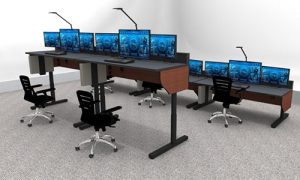
Sit-stand control room consoles add electric height adjustment to either premium enclosed or open-frame base designs, enabling operators to transition between sitting and standing positions throughout their shifts. These systems typically provide 12-18 inches of vertical travel, completing transitions in 20-30 seconds, with memory controls allowing operators to save preferred positions for quick recall.
The operational benefits of sit-stand capability have moved from theoretical wellness discussions to documented performance improvements in mission-critical environments. Operators report reduced fatigue during overnight shifts when position variation provides physical stimulation, offsetting the natural circadian decline in alertness. Back and leg discomfort—common complaints during extended sitting—decreases substantially when operators alternate positions hourly. Some operators maintain better focus while standing during high-tempo operations, preferring seated positions during routine monitoring, with the flexibility to match position to workload, improving overall performance.
Beyond individual operator benefits, sit-stand consoles provide organizational advantages. Facilities that host operators with varying physical conditions or limitations gain flexibility to accommodate diverse needs without custom furniture modifications. Supervisory positions benefit particularly from stand-capable workstations, as the elevated perspective improves visual oversight of operator screens while the position change reinforces supervisory presence during critical events.
Modern workforce expectations increasingly include ergonomic workplace investments, making sit-stand capability a recruitment and retention tool for facilities competing for skilled operators in tight labor markets.
The primary consideration limiting sit-stand adoption remains cost—these systems typically command 25-40% premiums over equivalent static-height consoles. Organizations must evaluate whether the operational benefits and workforce advantages justify these incremental costs, given budget constraints and competing priorities. Many facilities adopt hybrid approaches, deploying sit-stand consoles for supervisory positions and selected operator workstations with particularly demanding shifts while using static-height systems elsewhere, optimizing budget allocation while providing height adjustment where it delivers the highest value.
See Our Console Solutions in Action
Here’s a brief visual overview of the Command Watch, Command Flex, and Command Flex Sit-Stand console lines discussed in this guide.
Essential Design Features and Specifications
Regardless of console category—premium enclosed, open-frame, or sit-stand—certain design features fundamentally determine whether furniture effectively supports mission-critical operations across long service lives. Understanding these essential specifications helps organizations evaluate vendor proposals, compare alternative products, and avoid compromises that seem minor initially but create significant operational limitations over time.
Structural Capacity and Construction Quality
The foundation of any control room console is its structural framework. Mission-critical operations demand furniture that can reliably support substantial equipment loads over decades of continuous use while maintaining stability under various loading conditions. Inadequate structural capacity leads to console deflection, affecting monitor alignment; vibration transmitted through work surfaces degrades video quality or creates operator discomfort; and premature mechanical failure requires expensive repairs or replacements.
Professional control room consoles typically specify load capacities of 200-400 pounds per operator position distributed across work surfaces, slatwall mounting systems, and equipment cavities. This capacity must account not just for current equipment but also for future additions as technology evolves and missions expand. Heavy-gauge steel construction—14 to 16 gauge for structural members—provides the strength and rigidity required for these loads. Aluminum frames can deliver comparable performance when properly engineered, but require careful attention to reinforcement and bracing details.
Beyond raw load capacity, construction quality manifests in details: fully welded joints rather than mechanical fasteners that loosen over time, powder-coated finishes for corrosion resistance and durability, adjustable leveling feet that compensate for floor irregularities, and reinforced mounting points for equipment and accessories. These seemingly minor specifications distinguish furniture engineered for mission-critical applications from products adapted from office or light-commercial markets.
Pro Insight: When evaluating console construction, request written load capacity specifications with supporting engineering documentation rather than accepting verbal assurances. Reputable manufacturers provide detailed capacity ratings and can supply engineering drawings showing structural details. Reluctance to provide this documentation often signals that products are not actually engineered for the stated capacities, creating a risk of premature failure under operational loads.
Ergonomic Optimization and Adjustability
Ergonomics in control room furniture extends beyond providing comfortable seating—it encompasses the entire operator interface with technology, information, and teammates. Effective ergonomic design reduces fatigue, maintains alertness, prevents repetitive strain injuries, and supports the sustained concentration required for complex monitoring tasks.
Work surface geometry represents the starting point for ergonomic evaluation. Depth should provide adequate space for keyboards, mice, notebooks, and incidental items without forcing operators to overreach for equipment or crowd their personal workspace. Width must accommodate multiple monitors, reference materials, and the communication tools operators use during coordination activities. Height—whether fixed or adjustable—should support proper elbow angles and wrist positioning for keyboard use while allowing monitor placement at eye level or slightly below to maintain neutral neck posture.
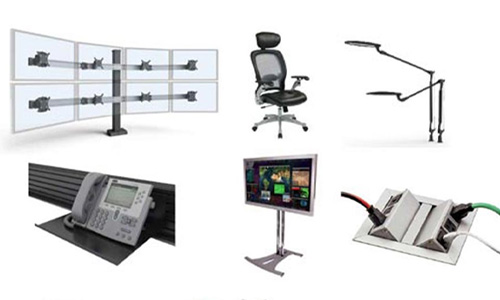
Monitor positioning flexibility proves critical given the 4-8 screen arrays common in modern control rooms. Slatwall mounting systems, adjustable monitor arms, or mounting rails should enable operators to configure displays matching their individual preferences and visual acuity. The ability to adjust monitor height, distance, tilt, and angle transforms generic console furniture into personalized workstations supporting each operator’s specific requirements—important when multiple personnel use the same console across different shifts.
Sightline considerations extend beyond personal monitors to shared displays. Console heights, equipment section profiles, and overall geometry should maintain clear visibility to video walls, presentation areas, and supervisory stations without requiring operators to crane necks, lean excessively, or leave their positions to see critical information. Open sightlines also support peripheral awareness, which enables teams to coordinate responses during complex events.
Comprehensive Cable Management Infrastructure
Cable management might seem like a secondary consideration compared to structural capacity or ergonomics, but experienced control room operators and facility managers consistently identify inadequate cable infrastructure as one of the most frustrating deficiencies in poorly specified console systems. The consequences of poor cable management accumulate over the life of a facility, creating ongoing operational friction, safety hazards, and maintenance complications.
Professional cable management begins with horizontal raceways running along console bases, providing protected pathways for power cables, network connections, fiber optic runs, and signal cables between equipment locations and operator positions. These raceways should provide generous capacity—typically 4-6 inches wide and 2-4 inches deep—accommodating current cabling plus 30-50% spare capacity for future additions. Removable covers, hinged lids, or sliding panels should enable cable access without tools, facilitating the adds, moves, and changes that occur regularly throughout facility operations.
Vertical cable management complements horizontal raceways by organizing the transition from console bases to elevated equipment like monitors, computers, or network switches. Vertical managers—whether integrated columns, external raceways, or slatwall-mounted channels—prevent cable sag, maintain organized separation between power and signal cables, and protect connections from physical damage or accidental disconnection.
Work surface integration via grommets, cable ports, or power/data modules provides clean transitions for cables serving keyboards, mice, phones, and portable devices without cluttering the surface or creating trip hazards. Pop-up or retractable modules maintain a clean, aesthetic look when not in use while providing convenient access when needed. The specific mechanisms matter less than ensuring operators can easily connect and disconnect equipment without crawling under consoles or fighting tangled cables.
Equipment Housing and Thermal Management
Many control room applications require equipment to be housed within or beneath console furniture—computers driving multiple monitors, KVM switches managing multiple systems, network equipment, uninterruptible power supplies, or specialty devices specific to particular operations. Effective equipment housing balances accessibility, ventilation, and protection.
Equipment cavities should provide adequate volume for current devices plus reasonable growth capacity. Dimensions accommodating standard rack-mount equipment (19-inch wide) enable the use of off-the-shelf mounting rails and hardware. Ventilation provision, like perforated panels, fan mounting locations, or adequate clearances, prevents heat buildup that degrades equipment reliability and shortens component lifespans. In enclosed console designs, ventilation paths should either enable natural convection or accommodate small fans to move air through equipment cavities without creating excessive noise at operator positions.
Access provisions enable equipment service without disrupting operations. Removable panels, hinged doors, or slide-out shelves allow technicians to reach equipment for installation, maintenance, or troubleshooting. Cable management within equipment cavities (using mounting strips, cable ties, and clear routing paths) prevents the disorder that makes troubleshooting time-consuming and increases the probability of mistakes during equipment changes.
Some control room designs house major equipment in separate rooms, leaving console furniture to accommodate only peripheral devices. This approach simplifies console specifications while concentrating cooling, power distribution, and cable infrastructure in equipment rooms designed specifically for those purposes. However, it requires adequate cable capacity between equipment rooms and console areas, plus careful planning to ensure future additions don’t exhaust cable pathways.
Modular Architecture and Reconfiguration Capability
Control room missions evolve continuously throughout the facility’s lifespan. Organizations expand, operational requirements change, new technologies emerge, and missions pivot in response to external factors. Console furniture locked into fixed configurations becomes an expensive liability when these changes require complete replacement rather than reconfiguration.
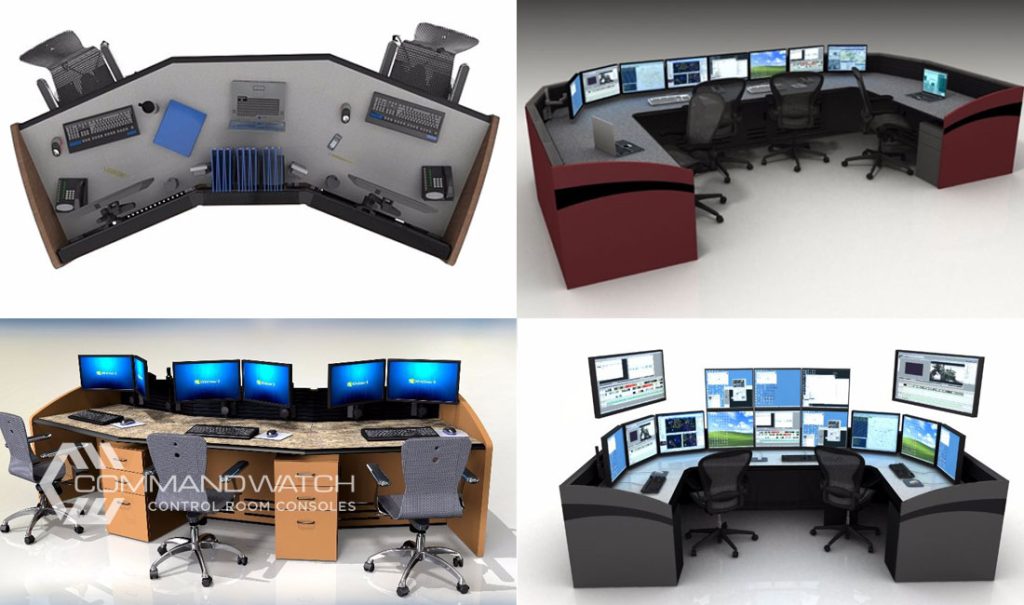
Modular console architectures use standardized components that connect in various arrangements, enabling facilities to start with initial configurations and then expand, contract, or reorganize as requirements change. A basic modular system might include straight sections, corner units, end caps, and equipment bay modules that combine into linear rows, L-shaped configurations, curved arrays, or team pod arrangements. More sophisticated systems add specialty components—supervisor stations, printer stands, instructor positions, or collaboration tables—further extending configuration options.
True modularity requires more than just component variety—it demands practical reconfiguration processes. The best systems allow facility personnel to make common changes with basic tools and reasonable effort, rather than requiring specialized equipment, factory technicians, or complete disassembly. Quick-connect electrical systems, tool-free mechanical fasteners, and straightforward assembly sequences differentiate genuinely modular products from systems claiming modularity while demanding extensive labor for any modification.
Key Consideration: When evaluating modularity claims, ask vendors to demonstrate actual reconfiguration processes—either through video documentation or, ideally, hands-on demonstration with physical components. Some products marketed as modular prove difficult or expensive to modify in practice, undermining the flexibility that makes modularity valuable.
Industry-Specific Console Requirements
While fundamental console requirements—structural capacity, ergonomics, cable management, and modularity—apply broadly across mission-critical environments, different industries impose unique priorities and specifications reflecting their distinct operational characteristics. Understanding these industry-specific considerations helps organizations select console systems that are truly optimized for their applications rather than accepting generic solutions that require extensive customization or operational compromises.
Network Operations and Data Centers
Network operations centers monitor the complex technology infrastructure supporting modern organizations, requiring operators to synthesize information from dozens of monitoring systems, rapidly diagnose problems, and coordinate responses with technical teams. These environments typically feature high operator density—10-20+ positions in relatively compact spaces—plus extensive multi-monitor arrays displaying network status, performance metrics, security dashboards, and ticketing systems.
Console requirements in NOC environments emphasize monitor-mounting flexibility supporting 6-8 screens per position, cable management accommodating the dense network connections required for IP-based monitoring systems, equipment housing for workstation computers and KVM systems, and sightline optimization to ensure all operators can see shared video walls displaying network-wide status. Premium enclosed consoles are frequently used for these applications, given the professional appearance desired in facilities hosting customer tours and executive visits.
Emergency Dispatch and Public Safety
Emergency operations centers and 911 dispatch facilities face unique stressors—life-safety responsibility, high-stress interactions, mandatory performance standards, and public scrutiny during incidents. Operators work rotating shifts in environments designed for rapid situational awareness and coordinated emergency response across multiple agencies.
Console requirements for emergency dispatch prioritize ergonomic features that support sustained performance during 12-hour shifts, sit-stand capability to help maintain alertness during overnight operations, acoustic considerations to reduce cacophony when multiple dispatchers handle simultaneous calls, and equipment integration to support specialized CAD systems, radio consoles, and mapping displays that these facilities depend on. Many agencies specify sit-stand consoles for all positions rather than selected workstations, given the demanding nature of dispatch work and the wellness focus in modern public safety organizations.
Military and Defense Operations
Military command centers and defense operations facilities operate under requirements extending beyond civilian commercial standards. Security considerations, classified equipment housing, electromagnetic compatibility specifications, and government acquisition regulations all influence console selection and configuration decisions.
Console requirements in defense applications include structural robustness appropriate for permanent facilities and deployable configurations, equipment security through enclosed designs with locking panels, compliance with military specifications for materials and construction, cable management supporting multiple security classification levels, and vendor capabilities including security clearances and government contracting experience. While premium enclosed consoles predominate in permanent command centers, some military applications deploy ruggedized versions of commercial consoles adapted for their specific requirements.
Transportation and Aviation Control
Transportation control facilities and airport operations centers coordinate complex logistics involving vehicles, personnel, cargo, and passengers across distributed infrastructure. These environments require sustained situational awareness of multiple concurrent activities, rapid communication with field personnel, and coordination with external agencies during incidents or weather events.
Console requirements for transportation operations emphasize clear sightlines to shared displays showing system-wide status maps, integration of communication equipment for radio systems and telephone networks, space for reference materials, including procedures and contact directories, and durable construction that withstands 24/7 operations. Both premium enclosed and open-frame consoles serve these applications, depending on budget priorities and facility visibility levels.
Utility and Energy Management
Utility control rooms monitor and manage electric grids, water systems, natural gas distribution, and other infrastructure networks serving entire regions. Operators work with SCADA systems, alarm management platforms, and predictive analytics tools while maintaining readiness to respond to equipment failures, weather events, or cyber incidents threatening infrastructure reliability.
Console requirements for utility applications include robust construction appropriate for facilities operating continuously for decades, equipment housing for SCADA workstations and redundant systems, extensive monitor mounting supporting the complex display arrays utility operators use, and modular designs enabling incremental facility expansions as service territories grow. Premium enclosed consoles predominate given the mission-critical nature of utility operations and the long-term facility-planning horizons typical of regulated utility industries.
Financial Considerations and Total Cost of Ownership
Console furniture represents a significant capital investment requiring careful financial evaluation. However, purchase price alone provides an inadequate basis for selection decisions—total cost of ownership across expected service lives reveals the true economic impact of alternative approaches and frequently inverts conclusions drawn from initial cost comparisons alone.
Understanding Price Ranges and Cost Drivers
Control room console pricing varies substantially based on product category, features, materials, and vendor positioning. Open-frame modular consoles typically range $2,500 to $6,500 per operator position for basic configurations, increasing toward the higher end of the range when adding extensive monitor mounting, equipment bays, and accessory packages. Sit-stand variants of open-frame designs command $4,500-12,000 per position depending on quality levels, lift mechanism capabilities, and feature content. Premium enclosed consoles range from $ 6,000 to $15,000+ per position, with sophisticated configurations for demanding applications potentially exceeding $20,000 per position when including extensive customization, specialty finishes, or advanced technology integration.
Several factors drive cost variations within these ranges. Physical size—measured in linear feet of console frontage—directly impacts material costs and pricing. Technology integration complexity, including specialized equipment housing, advanced cable management, or custom electrical distribution, adds cost reflecting engineering and manufacturing requirements. Surface materials and finishes, ranging from economical laminates to premium solid surfaces and specialty coatings, affect both initial costs and long-term durability. Customization beyond standard configurations—whether dimensional modifications, color matching, or specialty features—commands premiums reflecting the non-recurring engineering and setup costs involved.
Installation represents an often-overlooked cost component. Professional installation by experienced technicians ensures proper assembly, precise alignment, complete cable integration, and thorough quality verification, but typically adds 15-25% to furniture costs depending on project complexity, site accessibility, and geographical location. Attempting to save installation costs by using internal facility staff or general contractors without control room experience often results in costly corrections and operational disruption during extended installations.
Bonus Tip: When comparing vendor quotes, ensure pricing includes equivalent scopes—some vendors quote furniture only while others include installation, electrical integration, and project management in base pricing. Creating an apples-to-apples comparison requires explicit understanding of what each proposal includes and excludes, then normalizing quotes to reflect total installed costs, including all services required for operational readiness.
Calculating Long-Term Value
The economic analysis that matters most examines the total cost of ownership across expected console service lives—typically 15-20 years in mission-critical facilities. This perspective reveals that initial purchase prices, while important, represent only one component of lifetime costs, and that incremental investments in higher quality frequently deliver superior long-term value.
Maintenance and repair costs vary dramatically between quality tiers. Premium consoles using commercial-grade components and robust construction might require $200-400 annually per position for routine maintenance and occasional component replacement. Budget-oriented furniture with lighter construction and residential-grade hardware often requires $600-1,200 annually to address premature failures, mechanical adjustments, and incremental repairs to address design deficiencies. Over a 15-year service life, the maintenance differential alone can exceed initial purchase price differences.
Reconfiguration costs reflect modularity and flexibility. Facilities expanding by 3-4 operator positions using truly modular console systems might spend $15,000-30,000 adding modules that integrate seamlessly with existing installations. Facilities using less flexible systems or discovering their furniture cannot accommodate needed changes often face $60,000-120,000 complete replacements, addressing what should have been routine expansions. The ability to adapt economically to changing requirements proves enormously valuable over multi-decade facility lifespans.
Replacement timing drives cumulative costs substantially. Quality console systems providing 18-20 years of reliable service before requiring replacement might cost 30% more initially than budget alternatives lasting 8-10 years, yet deliver 40-50% lower lifetime costs by avoiding mid-life replacement cycles. The avoided business disruption during premature replacements adds further value, difficult to quantify but nonetheless real.
Operator productivity has the largest financial impact but is also the most difficult to measure precisely. If quality console furniture improves operator efficiency by even 2-3% through better ergonomics, reduced fatigue, and enhanced situational awareness, the productivity value across a 15-person control room operating 24/7 easily exceeds $100,000-200,000 annually—dwarfing furniture costs within a few years. While precisely quantifying these gains proves challenging, the directional impact is clear: furniture that helps operators perform better delivers returns far exceeding initial investment.
Implementation Planning and Project Management
Successful control room furniture implementations require careful planning, coordination with multiple trades and vendors, and systematic project management to ensure all elements integrate properly into functional operational environments. Organizations that approach these projects casually or delegate them entirely to furniture vendors without active engagement frequently encounter problems that delay commissioning, compromise operational effectiveness, or require costly corrections.
Facility Assessment and Requirements Definition
Effective implementations begin with a thorough assessment of facility characteristics, operational requirements, and organizational priorities. Physical facility assessment includes accurate measurements of room dimensions, floor-to-ceiling heights, and any architectural features constraining furniture placement. Structural evaluation verifies floor load capacity adequate for planned equipment and furniture—particularly important in upper-floor facilities where concentrated loads might exceed building design specifications.
Electrical assessment examines available power capacity, circuit locations, and whether upgrades are necessary to support planned equipment loads. Network infrastructure review identifies cable entry points, available pathways to operator positions, and capacity for additional connections required by new equipment.
Defining operational requirements demands input from multiple stakeholders. Operators provide crucial insights into workflow patterns, information relationships, and practical considerations affecting daily effectiveness. Supervisors identify coordination requirements, training needs, and operational policies affecting console specifications.
Technical staff clarify equipment requirements, integration challenges, and maintenance considerations influencing design decisions. The synthesis of these diverse perspectives yields requirement specifications that balance competing priorities rather than optimizing for any single stakeholder group.
Design Development and Layout Optimization
Professional control room design services provide significant value during this phase, particularly for organizations lacking internal expertise in control room planning. Experienced designers understand the unique requirements of mission-critical environments, have extensive knowledge of available furniture products and their capabilities, and can develop layouts that optimize space utilization, sightlines, workflows, and future flexibility.
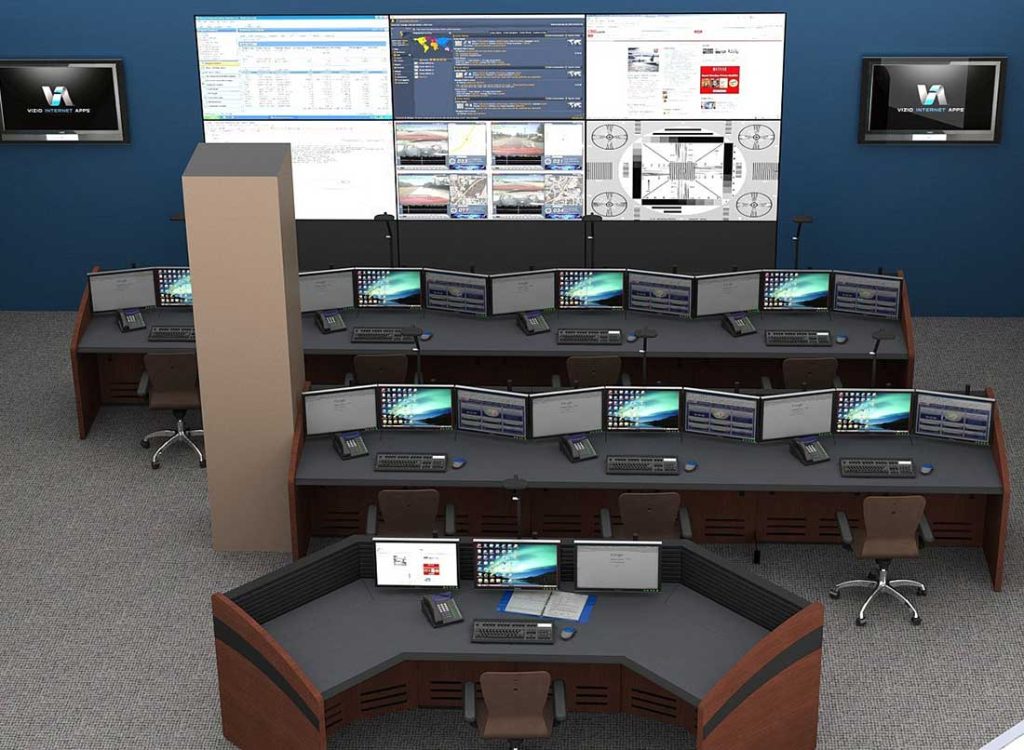
Layout development should consider multiple factors beyond simply fitting required operator positions into available space. Video wall positioning affects sightline requirements and console orientation. Equipment room locations influence cable routing and determine whether consoles need integrated equipment housing. Supervisory positions require placement enabling visual oversight of operator screens.
Acoustic considerations might dictate console arrangements separating quiet analytical work from communication-intensive dispatch functions. Future expansion possibilities should inform initial layouts, ensuring growth paths don’t require complete reorganization.
Mock-ups and visualization tools help stakeholders evaluate proposed layouts before committing to purchases. Full-scale mockups using temporary materials or reconfigurable furniture enable operations personnel to experience proposed configurations, test workflows, and identify problems that may be missed in two-dimensional drawings. Virtual reality tools and 3D renderings provide realistic previews of sight lines, spatial relationships, and aesthetic character, helping decision-makers gain confidence in designs before implementation.
Common Console Furniture Specification Mistakes to Avoid
Organizations new to control room furniture procurement often make predictable errors that compromise results:
- Underestimating equipment weight leads to console deflection, instability, or premature mechanical failure
- Insufficient cable capacity forcing exposed cable runs, limiting future equipment additions, or requiring expensive modifications
- Inadequate power distribution creates dependency on extension cords and power strips that clutter workspaces
- Fixed monitor mounting, preventing ergonomic adjustments and forcing all operators to accept identical configurations
- Minimal equipment housing leaves no room for growth as technology requirements expand
- Ignoring maintenance access makes equipment service difficult and time-consuming during operations
- Overlooking the sit-stand capacity for supervisory positions where the capability provides the highest value
- Specifying based on appearance alone without verifying structural capacity, modularity, and long-term durability
- Choosing the cheapest option without calculating the total cost of ownership, including maintenance and replacement cycles
Vendor Selection and Procurement
Vendor selection should evaluate capabilities beyond product offerings. Installation experience proves critical—vendors with documented experience in mission-critical facilities understand the coordination, precision, and project management these installations demand.
Engineering support helps address technical challenges during design and specification phases. Service capabilities, including warranty support, parts availability, and response times, affect long-term ownership experience. Financial stability indicates that vendors will remain viable and provide support throughout the console furniture’s service life.
Procurement processes vary by organization type. Government agencies typically require formal competitive bidding following detailed specifications, with awards based on combinations of price and qualification factors. Cooperative purchasing programs enable some public sector organizations to bypass individual procurements by leveraging contracts negotiated by larger entities. Private sector organizations enjoy greater flexibility, often using competitive quotes from qualified vendors or direct negotiations with preferred suppliers.
Contracts should explicitly define scope, responsibilities, and deliverables. Furniture specifications, including models, quantities, features, finishes, and accessories, prevent surprises when equipment arrives. Installation services detailing assembly, alignment, cable integration, and cleanup establish clear expectations.
Project schedules identifying milestones and completion dates enable progress tracking. Warranty terms covering parts, labor, and duration protect against premature failures. Payment terms should tie compensation to milestone achievement rather than upfront payments, creating vendor leverage while exposing owners to completion risk.
Installation Coordination and Quality Verification
Professional installation requires coordination with electrical contractors, network technicians, audiovisual integrators, and other trades working simultaneously in control room spaces. Effective project management ensures these diverse activities occur in logical sequences without conflicts or delays. Console installation typically occurs after architectural construction is complete and electrical rough-in is finished, but before final equipment installation and cable termination.
This sequencing allows furniture placement and alignment before cable pulling, while enabling equipment mounting and connections after consoles reach their final positions.
Quality verification during installation catches problems when correction costs remain modest. Dimensional verification ensures consoles match design intent and fit properly in available space. Structural inspection confirms a solid assembly with no loose fasteners, gaps, or misalignments. Functional testing verifies that moving parts like sit-stand mechanisms, drawers, or access panels operate smoothly.
Finish inspection identifies damage requiring repair before acceptance. Cable management review ensures organized routing and adequate service loops. The systematic verification creates punch lists documenting items requiring attention before final acceptance.
Operator training in console features and proper use pays dividends in extended equipment life and improved ergonomics. Training should cover adjustment mechanisms, including monitor positioning, sit-stand operation, and any specialized features. Cable management protocols for connecting personal devices prevent damage and maintain organization.
Maintenance requirements, including cleaning procedures and periodic inspections, help operators participate in console care. Access procedures for equipment service ensure technicians can perform necessary work without disrupting adjacent operators.
Emerging Trends Shaping Control Room Furniture Evolution
Control room furniture continues evolving in response to changing technology, operational methodologies, and workforce expectations. Organizations designing facilities today should consider these trends, ensuring investments remain relevant throughout long service lives rather than becoming outdated as operational practices advance.
Key Technology Trends Impacting Console Design
Modern control room furniture must adapt to several converging technology shifts:
- Higher-resolution displays require updated mounting systems capable of supporting larger, heavier 4K and 8K monitors
- Ultra-wide and curved screens create immersive viewing experiences that demand flexible positioning hardware
- Increased computing power generates more heat and requires enhanced ventilation in equipment cavities
- Edge computing devices are adding equipment density at operator positions beyond traditional workstations
- Wireless peripherals are reducing cable clutter while requiring integrated charging solutions and RF-transparent materials.
- Touchscreen interfaces are becoming standard in some applications, influencing work surface angles and monitor positioning.
- Cloud-based applications are shifting processing away from local hardware, but increasing network bandwidth requirements
Hybrid and Distributed Operations Models
The traditional model of all operators co-located in centralized control rooms is beginning to fragment. Some organizations operate hybrid models with core teams in central facilities supplemented by remote operators providing surge capacity or specialized expertise.
Others implement fully distributed operations with operators working from diverse locations coordinated through collaboration technology. These evolving operational models influence furniture requirements in multiple ways.
Central facilities supporting hybrid operations need flexibility to accommodate variable operator counts as personnel rotate between the facility and remote work. Quick-setup provisions enable rapid configuration of additional workstations from stored components, supporting surge staffing during major events.
Technology integration, emphasizing video conferencing and collaboration tools, enables seamless coordination with remote personnel. Environmental quality, including professional appearance and acoustic control, becomes more important as facility-based operators increasingly appear in video calls with remote colleagues and leadership.
Distributed operations create opportunities for more economical console deployments, since remote operator environments need not match the density and capabilities required in centralized facilities. Organizations might deploy premium enclosed consoles in central command positions while equipping remote operators with open-frame systems appropriate for home offices or satellite locations. This tiered approach optimizes budget allocation while ensuring critical positions maintain required capabilities.
Advanced Display Technologies and Visualization
Display technology advancement continues to accelerate with implications for console design and capability requirements. Higher-resolution displays—4K and 8K—enable greater information density on individual screens, potentially reducing the number of monitors per position. Ultra-wide displays and curved screens create immersive viewing experiences, particularly valuable for geospatial applications and network visualization. LED display technology improves video wall performance while reducing depth requirements and simplifying installation.
These display advances require console furniture to adapt in several dimensions. Monitor mounting systems must accommodate larger screen sizes and different form factors without requiring console redesign. Weight capacity specifications should account for heavier high-resolution displays. Cable infrastructure must support the increased bandwidth requirements of 4K and 8K video. Equipment housing needs capacity for the more powerful graphics processors and workstations driving advanced display arrays. Adjustability remains crucial, as optimal viewing distances and angles vary with screen size and resolution.
Artificial Intelligence and Automation Integration
AI-driven automation is beginning to transform control room operations, with algorithms handling routine monitoring tasks and anomaly detection while escalating complex situations requiring human judgment to operators. This shift affects workforce requirements, operator role definitions, and the physical workspace supporting evolving operational models.
As automation assumes routine monitoring, operator roles emphasize exception handling, strategic decision-making, and coordination—activities benefiting from different physical workspace characteristics than constant vigilance. Consoles might incorporate larger collaborative work surfaces supporting team problem-solving sessions.
Display configurations could shift toward fewer, larger screens that show synthesized information rather than dozens of detailed monitoring feeds. Furniture layouts might create more flexible team spaces rather than rigid rows of individual operator positions.
Creative Approach: Forward-thinking organizations designing control rooms today should plan for multiple operational models—traditional manual monitoring, AI-augmented operations, and potentially fully automated systems with human oversight. Console modularity and flexibility, enabling reconfiguration as operational models evolve, provides insurance against making large fixed investments in furniture optimized for operational approaches that might change substantially within 5-10 years.
Wellness and Operator Experience Focus
Workforce expectations of workplace quality continue to rise, with operators increasingly viewing employment environments as reflections of organizational values and factors in career decisions. Control rooms, historically designed purely for function, are incorporating wellness considerations, aesthetic refinement, and experience quality to support recruitment, retention, and operator satisfaction.
Sit-stand furniture represents the most visible wellness investment, but holistic approaches extend further. Environmental quality, including lighting design, acoustic comfort, temperature control, and air quality, influences operator wellbeing and performance. Aesthetic considerations, recognizing that operators spend significant portions of their lives in these spaces, justify investments in finishes, colors, and overall visual quality beyond purely utilitarian approaches.
Personal workspace customization, allowing operators to adjust their immediate environments, supports the diversity of individual preferences rather than forcing everyone into identical configurations.
These wellness investments serve pragmatic purposes beyond humanitarian considerations. Facilities with superior environmental quality and operator amenities experience lower turnover, reducing the substantial costs of recruiting and training replacements. Operator satisfaction influences performance, with engaged personnel demonstrating better situational awareness and more effective responses during critical events. Organizations competing for skilled technical personnel find that workspace quality factors into candidates’ decisions, making control room environments a potential differentiator in tight labor markets.
Frequently Asked Questions About Control Room Furniture
What’s the typical lifespan of quality control room console furniture in continuous 24/7 operations?
Professional-grade control room consoles, properly maintained, typically provide 15-20 years of service in continuous operation. This longevity depends on quality construction with heavy-gauge steel or aluminum frames, commercial-grade hardware designed for intensive use, durable work-surface materials like high-pressure laminate, and proper maintenance, including regular cleaning, periodic tightening of hardware, and replacement of components as needed.
Budget furniture or office products adapted for control room use often fail within 7-10 years under 24/7 use, ultimately costing more due to premature replacement requirements despite lower initial prices.
Should we prioritize premium enclosed consoles or invest saved budget in display technology and computing equipment?
This question presents a false choice—both furniture and technology matter for effective control room operations. However, the optimal balance depends on specific circumstances. Premium enclosed consoles provide lasting value through superior durability, professional appearance, and equipment protection, justifying their costs in high-visibility facilities, long-term installations, or applications requiring maximum equipment security.
Open-frame consoles deliver excellent functionality at lower costs, making them appropriate when budgets are constrained, aesthetics matter less than operational capacity, or equipment protection requirements are modest. The key insight is that display technology and computers require replacement every 5-7 years as capabilities advance, while quality console furniture lasts 15-20 years, suggesting it’s worth investing appropriately in furniture providing the long-term foundation rather than over-rotating toward technology that will need updating multiple times during furniture service lives.
How much space per operator position should we plan when designing control room layouts?
Professional control room console systems typically require 8-12 linear feet per operator position, depending on the number of monitors, equipment housing needs, and desired workspace generosity. Positions supporting 4-6 monitors with integrated equipment housing generally need 10-12 feet, while simpler configurations with 2-4 monitors might function adequately in 8-9 feet.
Between console rows, plan for a minimum of 8-10 feet to enable equipment access, maintenance activities, and comfortable movement behind operators. These spacing standards ensure operators don’t feel cramped while maintaining sightlines and allowing future equipment additions without a complete layout redesign. Tighter spacing is technically possible, but often proves problematic during equipment changes or when operators need to collaborate.
What’s involved in moving from static-height consoles to sit-stand systems in an existing control room?
Transitioning to sit-stand consoles in operating facilities presents several challenges. Sit-stand systems typically require more vertical clearance than static-height furniture—verify that ceiling heights and any suspended equipment, such as cable trays or HVAC, don’t constrain console height adjustment ranges.
Cable management must accommodate vertical movement, requiring service loops and flexible connections rather than tight cable routing that restricts motion. Existing equipment must be compatible with movement—some legacy devices with spinning hard drives or other mechanical components might not tolerate repeated motion. The transition itself requires the temporary displacement of operators during furniture replacement, which is complicated in 24/7 facilities where operations cannot stop.
Many organizations address these challenges through phased approaches, replacing consoles serving one or two positions at a time rather than entire rooms simultaneously, or timing transitions during major facility renovations when operational disruption is already expected.
How do we ensure selected console furniture can accommodate future technology generations we can’t predict today?
Future-proofing console furniture focuses on built-in flexibility and generous capacity rather than predicting specific technology evolution. Specify console infrastructure that exceeds current requirements: monitor mounting systems supporting heavier, larger displays than currently deployed; cable raceways with 30-50% spare capacity beyond immediate needs; equipment bays larger than current devices require; and power distribution with more circuits than initial equipment demands.
Choose modular console architectures that allow component additions or replacements without wholesale changes to furniture. Select vendors with a long-term market presence, suggesting they’ll remain available to support modifications as needed. Avoid overly customized designs optimized for current specific equipment—standardized systems using industry-standard mounting and connection methods adapt more readily as technology evolves.
What maintenance should we expect to perform on control room consoles, and how much should we budget annually?
Quality control room furniture requires minimal but important maintenance. Monthly tasks include cleaning work surfaces with appropriate products, verifying all fasteners remain tight, and inspecting cable management for organization and damage.
Quarterly activities should include lubricating sit-stand mechanisms, if applicable, testing adjustment features, and examining structural connections for signs of loosening or wear. Annual professional service might include a comprehensive inspection, replacement of worn components, refinishing any damaged surfaces, and updating mounting hardware for new equipment types.
Budget $200-400 per operator position annually for maintenance in facilities using premium consoles with professional service contracts, or $100-200 per position for open-frame systems with in-house maintenance. These investments prove far more economical than addressing deferred maintenance problems or replacing prematurely failed furniture.
Can we mix different console types in the same control room facility?
Mixing console types within facilities provides both opportunities and challenges. Strategic mixing makes sense when different positions have substantially different requirements—using premium enclosed consoles for high-visibility supervisory positions while deploying open-frame systems for operator workstations can optimize budget allocation. Similarly, sit-stand consoles might serve positions with particularly demanding shifts while static-height systems serve less intensive applications.
However, mixing creates aesthetic inconsistency that some organizations find objectionable, complicates maintenance and spare parts management, and might create perceived status differences between operator roles using different furniture. The decision should weigh practical benefits against these concerns, given specific organizational culture and operational requirements.
What certifications or standards should control room furniture meet?
Control room furniture should meet relevant commercial furniture standards, including BIFMA (Business and Institutional Furniture Manufacturers Association) specifications for structural performance, safety, and durability. Electrical components should comply with UL (Underwriters Laboratories) or equivalent safety certifications. Materials should meet flammability standards appropriate for commercial interiors—typically Class A or Class 1 for flame spread.
Ergonomic features should align with ANSI/HFES 100 human factors engineering standards. Government and military applications might require additional certifications, including GSA (General Services Administration) approval or compliance with military specifications. When evaluating vendors, verify they provide documentation of relevant certifications rather than simply claiming compliance—reputable manufacturers readily supply test reports and certification documents.
How does console furniture selection impact overall control room design and construction timelines?
Console furniture significantly influences project schedules through several mechanisms. Lead times for quality console systems typically range 8-14 weeks from order placement to delivery depending on product line, customization requirements, and manufacturer capacity. Custom configurations or specialty finishes can extend timelines to 14-18 weeks. These lead times must fit within overall project schedules—starting furniture procurement too late delays facility commissioning, while ordering too early risks design changes invalidating furniture specifications.
Console specifications affect architectural and electrical design—without finalized furniture selections, architects cannot detail power outlet locations, network connection points, or equipment room requirements. Installation typically requires 1-3 weeks, depending on facility size and complexity.
Smart project management sequences furniture selection early in design development rather than treating it as late-stage procurement, enabling designs that properly integrate furniture with ordering to ensure adequate lead time.
Should we consider leasing control room furniture rather than purchasing outright?
Furniture leasing provides potential benefits, including spreading costs over time without large capital expenditures, enabling equipment upgrades on defined schedules, and potentially providing tax advantages depending on organizational structure and accounting treatment.
However, leasing total costs typically exceed purchase prices by 30-60% when accounting for interest rates and lessor profit margins. Control room furniture’s long 15-20-year service life means organizations that purchase outright own assets with substantial remaining value after typical 5-7-year lease terms expire.
Leasing makes most sense for organizations with capital constraints that prevent outright purchases, those who prefer operational expense treatment over capital expenditures, or situations where furniture requirements might change substantially within shorter timeframes, making long-term ownership risky. Most control room operators find that outright purchase provides better long-term value, given the longevity of furniture and stable requirements.
Conclusion: Investing in Operational Excellence Through Quality Console Furniture
Control room furniture represents far more than office equipment filling space—it provides the essential interface between operators and the complex systems they monitor, the physical foundation enabling sustained attention and rapid response, and the infrastructure supporting technology integration essential for mission success. These specialized workstation systems directly influence operator performance, facility operational effectiveness, and the organization’s capability to achieve mission objectives over the decades these facilities typically serve.
Organizations approaching control room furniture selection should resist the temptation to minimize initial investment by compromising quality, using adapted office furniture, or specifying inadequately. The differential costs between professional control room consoles and improvised alternatives represent tiny fractions of total facility investment and operational budgets, yet profoundly impact the daily effectiveness of personnel whose performance determines mission success.
Console systems enabling operators to maintain focus, access information efficiently, and collaborate effectively with teammates deliver returns far exceeding their costs through enhanced operational outcomes.
The selection process should begin with a clear understanding of operational requirements, operator workflows, and organizational priorities rather than defaulting to familiar approaches or selecting primarily on initial price without considering total ownership costs.
Engage operators, supervisors, and technical staff in requirements definition. Evaluate how different console categories—premium enclosed, open-frame modular, or sit-stand systems—align with specific needs and priorities. Consider not just current requirements but also how missions might evolve over 15-20-year furniture service lives, ensuring selected systems provide the flexibility to accommodate change without forcing expensive replacements.
Partner with reputable vendors that demonstrate experience in mission-critical environments, engineering capabilities to support complex integrations, and service commitments to ensure long-term support. Invest appropriately in professional installation to ensure consoles reach their full potential rather than compromising through inexperienced implementation. Plan systematically for successful projects, coordinating furniture with broader facility design, construction schedules, and technology integration.
The missions your control room supports—whether emergency response, infrastructure management, security monitoring, or military operations—depend on operators maintaining peak cognitive performance during routine monitoring and critical events alike. Provide them with the workspace they deserve through professional console furniture engineered specifically for the demanding requirements of 24/7 mission-critical operations.
Contact Command Watch for a free console furniture design quote 🔗 Contact Us