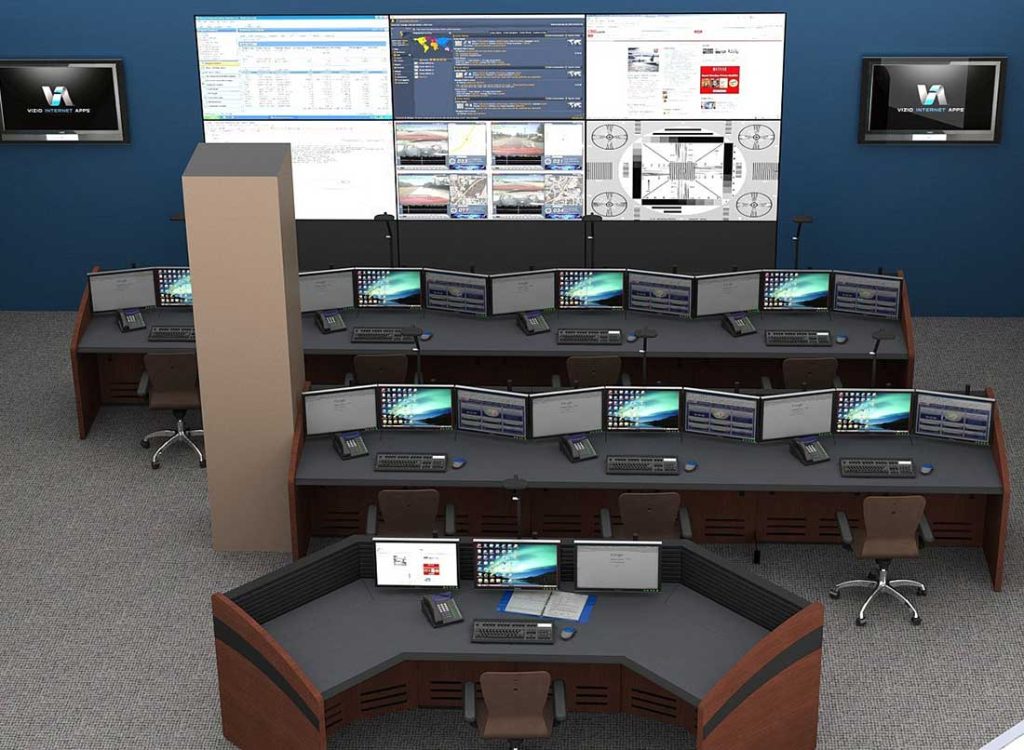
Security & Surveillance Control Rooms: Designing Consoles for 24/7 Monitoring Environments

Jump to a Section
Security and surveillance control rooms operate at the front line of risk prevention, incident response, and situational awareness. Whether supporting corporate security operations, transportation hubs, campuses, utilities, or public safety agencies, these environments demand constant vigilance, rapid decision-making, and uninterrupted system monitoring.
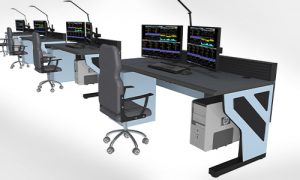
At the center of these operations is the control room console, the physical workspace that supports operators throughout extended shifts, dense technology use, and high-pressure scenarios. Purpose-built console furniture plays a critical role in enabling performance, reducing fatigue, and maintaining long-term operational reliability in modern security control rooms.
TL;DR – Quick Summary
Operational Reality: Security and surveillance control rooms operate 24/7 and require console furniture designed for continuous monitoring, fast response, and sustained operator focus.
Design Priority: Ergonomic consoles with proper sightlines, cable management, and multi-monitor support directly improve situational awareness and reduce fatigue.
Technology Density: Surveillance environments demand furniture that safely supports large display arrays, video walls, and secure equipment housing.
Future Readiness: Modular console systems allow security operations to scale, reconfigure, and adapt as technology and threat profiles evolve.
The Unique Demands of Security & Surveillance Control Rooms
Unlike traditional office environments, security control rooms must support uninterrupted operations. Operators monitor dozens—sometimes hundreds—of camera feeds, alarm systems, access controls, and communication platforms simultaneously. The physical workspace must be engineered to support this level of complexity without becoming a bottleneck.
Key operational demands include:
- Continuous monitoring across multiple displays
- Rapid response to evolving incidents
- Clear communication between operators and supervisors
- Long shifts with minimal physical movement
- High reliability under stress conditions
Generic office furniture simply isn’t built for this workload. Security control rooms require specialized control room consoles designed for mission-critical performance.
Ergonomics and Operator Performance in Surveillance Environments
Operator fatigue is one of the most significant risks in surveillance operations. Poor posture, awkward monitor placement, and cluttered work surfaces gradually degrade focus—often without operators realizing it until performance suffers.
Well-designed security consoles address this through:
- Proper monitor positioning to maintain neutral neck and eye alignment
- Height-appropriate work surfaces that reduce shoulder and wrist strain
- Clear sightlines to primary displays and video walls
- Adequate legroom and reach zones to support long seated sessions
Over time, ergonomic console design reduces error rates, improves alertness, and supports better decision-making—critical factors in security and surveillance control room operations.
Supporting Multi-Monitor and Video Wall Integration
Security control rooms are inherently display-intensive. Operators often rely on:
- Individual multi-monitor workstations
- Shared video walls for high-priority feeds
- Incident dashboards and mapping systems
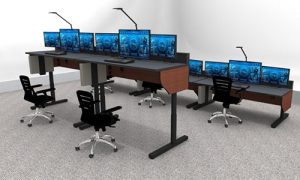
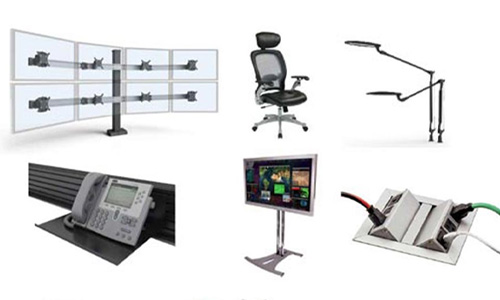
Console furniture must be engineered to support these configurations without sacrificing stability or accessibility. Integrated monitor mounting systems lift displays off the work surface, improving ergonomics while reclaiming valuable desk space.
In addition, consoles must align with broader monitor wall design strategies, ensuring viewing distances, sightlines, and lighting conditions work together across the room.
Cable Management and Equipment Organization
Security environments rely on dense technology stacks—cameras, servers, recorders, access control systems, and communications equipment. Without proper cable management, these systems quickly become difficult to maintain and unsafe to operate.
Purpose-built control room furniture incorporates:
- Integrated cable raceways
- Vertical and horizontal wire management
- Secure equipment bays
- Separation of power and data lines
Clean cable organization improves airflow, simplifies maintenance, reduces downtime, and supports long-term system reliability—an essential requirement in surveillance operations.
Reliability and Durability for 24/7 Use
Security control rooms don’t shut down. Furniture must withstand:
- Continuous use across multiple shifts
- Frequent operator turnover
- Heavy equipment loads
- Technology refresh cycles
Professional control room consoles are constructed with heavy-duty frames, reinforced work surfaces, and components rated for 24/7 environments. This durability protects both equipment and operators while extending the lifespan of the control room investment.
Modularity and Future Scalability
Threat environments evolve, technology advances, and organizations grow. Security control rooms must be able to adapt without requiring full facility redesigns.
Modular console systems allow organizations to:
- Add or remove operator positions
- Reconfigure layouts as workflows change
- Integrate new display technologies
- Expand monitoring capabilities over time
This flexibility ensures security operations remain effective and future-ready—without locking teams into outdated layouts or infrastructure.
Designing Security Control Rooms with Intent
Effective security control room design starts with understanding operational workflows, not just equipment counts. The most successful environments align console layout, ergonomics, technology integration, and sightlines into a cohesive system that supports both routine monitoring and high-stress incident response.
Organizations that invest in purpose-built control room furniture consistently see improvements in operator performance, system uptime, and long-term operational efficiency.
Contact Command Watch
For organizations planning or upgrading security and surveillance control rooms, thoughtful console selection is a foundational decision. If you’re evaluating layouts, technology integration, or long-term scalability, exploring professional control room furniture options early in the process helps avoid costly redesigns later.
Contact Information:
(800) 346-7521
cwsales@command-watch.com
Top Resource For Operators:
Essential Guide to Control Room Furniture
A detailed overview of console types, ergonomic features, technology integration considerations, and layout strategies for 24/7 mission-critical environments.