Military Command Center Console Design: Building Control Rooms for Mission-Critical Operations
Jump to a Section
TL;DR – Quick Summary
- Topic Overview: Military command centers require specialized control room furniture designed to support mission-critical operations, secure communications, and sustained operator performance in high-stakes environments.
- Key Considerations: Effective military console design prioritizes operator ergonomics, equipment accessibility, durability, survivability, and flexible layouts that can adapt to evolving operational requirements.
- Why It Matters: Poorly designed control room furniture can hinder decision-making, increase fatigue, and disrupt workflow—introducing risk in environments where clarity, speed, and accuracy are essential.
- Who This Is For: Defense facility planners, systems integrators, military operations teams, and organizations designing or upgrading command centers, network operations centers, or tactical control rooms.
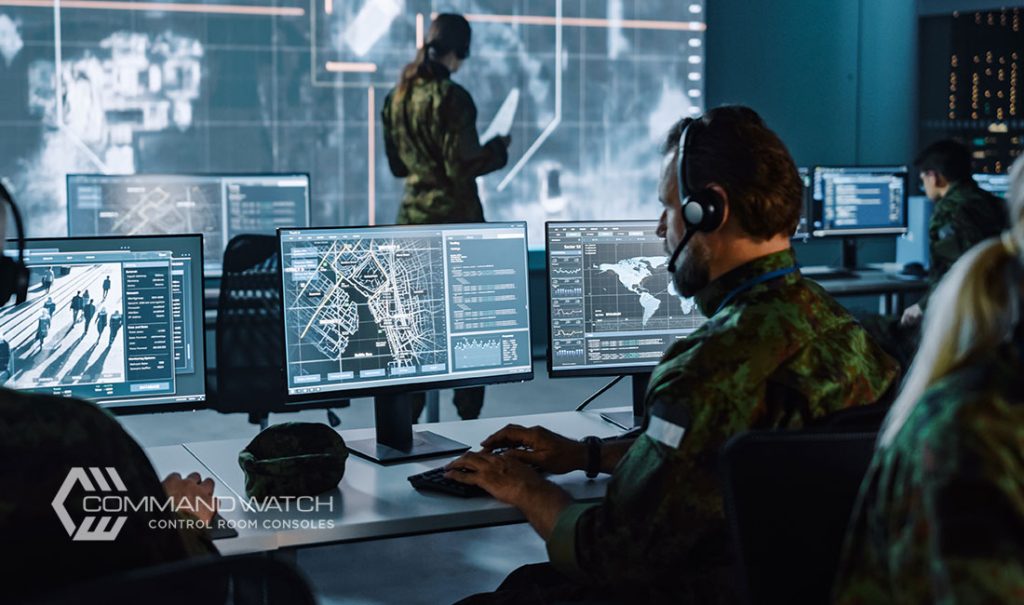
Military command centers serve as the operational backbone for defense, intelligence, training, and strategic coordination. These environments support real-time decision-making where clarity, speed, and reliability directly impact mission outcomes. Unlike conventional office spaces, military control rooms must be engineered to support continuous operations, secure communications, and evolving technology requirements, while maintaining operator performance under extreme conditions.
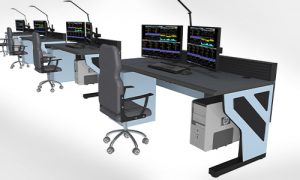
At the center of these environments is the control room console, not merely as furniture, but as critical infrastructure that supports situational awareness, communication flow, and operational endurance. Designing military command center consoles requires a specialized approach that prioritizes durability, adaptability, ergonomics, and integration with advanced systems.
Designing Military Control Room Consoles for Operational Effectiveness
Military console furniture differs fundamentally from commercial or corporate workstation design. These consoles must support dense technology deployments, multiple communication channels, classified systems, and extended shifts—all while remaining flexible enough to adapt to changing mission requirements.
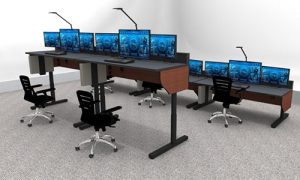
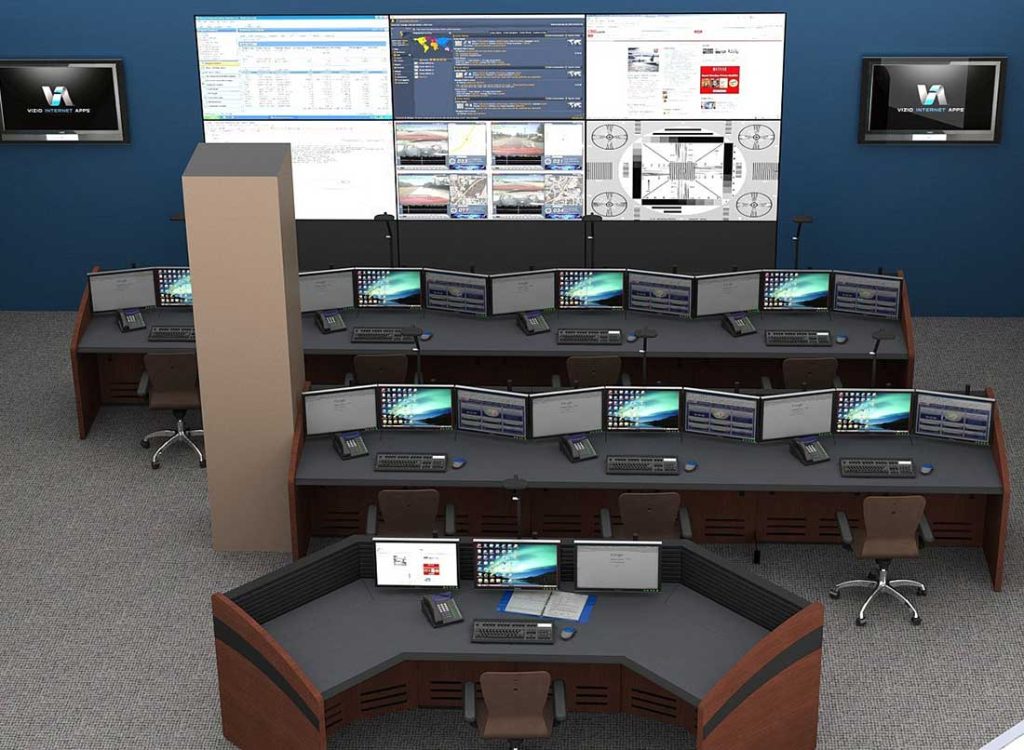
A well-designed military control room functions as a unified system. Displays, communications equipment, control interfaces, and data sources must be positioned so operators can access critical information instantly without physical strain or cognitive overload. Every operator position should be designed with a clear purpose, defined responsibilities, and seamless interaction with adjacent roles.
Customization is essential. No two command centers support identical missions, and console layouts must reflect operational workflows rather than forcing operators to adapt to static furniture designs.
Core Design Principles for Military Command Center Consoles
1. Integrated Communication and Workflow Flow
Military command centers coordinate information across multiple channels simultaneously—voice, data, video, and satellite communications. Console layouts must support fluid transitions between these systems without creating bottlenecks or distractions.
Effective console design ensures:
- Clear sightlines to shared displays and video walls
- Logical grouping of controls and interfaces by task
- Efficient handoff between operators and supervisors
- Support for both routine monitoring and surge operations
The physical arrangement of consoles directly affects how information moves through the room. Poor layout choices can slow response times and increase the risk of errors, while well-integrated designs enhance coordination and decision-making.
2. Resilience and Continuity Under Adverse Conditions
Military control rooms are often designed with continuity of operations in mind. Facilities may need to remain functional during emergencies, relocations, or operational disruptions. Console furniture must support these realities.
This includes:
- Structural durability suitable for high-stress environments
- Modular construction allows rapid deployment or reconfiguration
- Compatibility with temporary, mobile, or backup facilities
- Secure equipment housing for sensitive systems
Console systems should be robust enough to maintain functionality in both permanent installations and rapidly assembled environments without compromising operator effectiveness.
3. Durability for 24/7 Operations
Military command centers operate continuously, with operators spending long hours at their workstations. Console furniture must be built to withstand constant use while maintaining stability, safety, and performance over many years.
Key considerations include:
- Heavy-duty construction materials capable of supporting dense equipment loads
- Long-term structural integrity under continuous operation
- Finishes and surfaces resistant to wear, heat, and frequent maintenance
Durability is not just about longevity—it is about ensuring that furniture remains dependable during critical operations when failure is not an option.
4. Ergonomics Supporting Operator Readiness
Operator comfort directly impacts alertness, accuracy, and decision quality. Military operators must maintain focus during extended shifts, often under high-pressure conditions. Console ergonomics play a crucial role in sustaining performance and reducing fatigue.
Effective ergonomic console design supports:
- Neutral seated and standing postures
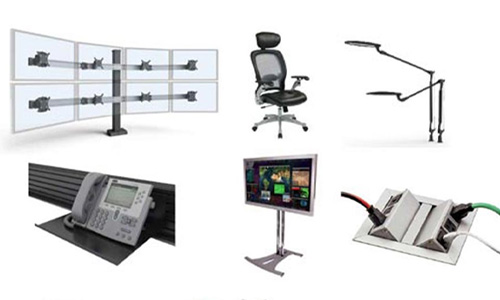
- Adjustable monitor positioning for multi-display environments
- Proper reach distances for controls and input devices
- Reduced physical strain over long operational periods
Ergonomics also contributes to workforce sustainability. Consoles that reduce physical stress help minimize injury risk, fatigue-related errors, and long-term health issues—factors that directly affect retention and operational continuity.
5. Flexibility and Reconfiguration Capability
Military operations evolve constantly, and control room layouts must evolve with them. Fixed, rigid furniture configurations limit adaptability and increase long-term costs.
Flexible console systems allow:
- Reconfiguration as missions change
- Expansion to accommodate new technology
- Reorganization for different operational tempos
- Scalability without full replacement
Modular console furniture ensures that command centers remain responsive to changing requirements rather than becoming constrained by outdated layouts.
Designing for Mission Success
Military command centers are not conventional workspaces—they are environments where decisions carry significant consequences. Console furniture must support the operators who rely on it and integrate seamlessly with technology, workflows, and security requirements.
Effective military control room design considers:
- Facility layout and location
- Equipment density and technology integration
- Operator performance and endurance
- Adaptability for future missions
By treating console furniture as a core component of operational infrastructure rather than an afterthought, organizations create command environments that support clarity, resilience, and mission readiness.
Supporting Military Control Room Design with Purpose-Built Consoles
Command Watch designs and manufactures modular control room consoles engineered for mission-critical environments, including military and defense applications. Our console systems are built to support 24/7 operations, high equipment density, and evolving operational demands—without compromising ergonomics or flexibility.
For more information on military command center console design, control room planning, or to request a customized solution, contact Command Watch today.
Phone: (800) 346-7521
Email: cwsales@command-watch.com
Industry Guide:
Control Room Consoles Buyer’s Guide A practical overview of workstation technologies, ergonomic features, and layout considerations for 24/7 mission-critical operations.