Command Center Acoustics: Designing Control Rooms That Support Operator Focus and Performance

Jump to a Section
Your comprehensive guide to understanding how acoustic design, noise control, and strategic furniture selection enhance operator concentration, communication clarity, and sustained performance in 24/7 mission-critical control room environments.
TL;DR – Quick Takeaways
Topic Overview: Acoustic design profoundly impacts control room operator performance, with proper noise control supporting concentration, clear communication, and reduced fatigue during extended shifts in mission-critical environments.
Key Insights: Effective acoustics require layered approaches integrating room design, console furniture selection, surface treatments, and HVAC coordination—achieving optimal background noise levels between 30-35 dB that enable operator focus without complete silence that hinders communication.
Who This Is For: Facility managers planning control room builds, operations directors seeking to improve operator performance, acoustic consultants designing mission-critical spaces, and organizations experiencing communication or concentration challenges in existing facilities.
Action Step: Assess current control room noise levels using professional sound measurement, identify primary noise sources and acoustic problem areas, and engage specialists who understand the intersection of acoustics, console design, and operational requirements.
Understanding Why Acoustics Matter in Mission-Critical Environments
Command centers serve as operational nerve centers for organizations, where situational awareness, rapid decision-making, and coordinated responses determine mission success. Operators in emergency communications centers, network operations facilities, utility control rooms, transportation coordination centers, and security monitoring environments maintain continuous vigilance over complex systems, respond to evolving situations, and communicate with teammates and external stakeholders throughout extended shifts.
The acoustic environment surrounding these operators—the background noise they work through, the clarity of alarms and communications, the reverberation affecting speech intelligibility—directly influences their cognitive performance, communication effectiveness, and ability to maintain focus during both routine operations and crisis situations.
Yet acoustic considerations frequently receive inadequate attention during control room planning. Organizations invest substantial resources in specifying display technology, selecting software platforms, and developing staffing models, while treating acoustics as an afterthought to be addressed only if problems emerge after facilities become operational. This priority inversion proves problematic because acoustic problems in completed facilities typically require expensive interventions—adding sound-absorbing treatments, modifying HVAC systems, or even relocating equipment—that cost far more than incorporating proper acoustic design from project inception.
The impact of poor acoustics manifests across multiple dimensions, affecting operational effectiveness. Excessive background noise forces operators to increase communication volume, creating feedback loops that escalate overall noise levels throughout shifts. Unclear communication due to poor speech intelligibility leads to misunderstandings that require clarification, slowing response times in situations where seconds matter.
Alarm systems competing with high background noise must operate at volumes that create stress and alarm fatigue rather than provide clear notifications. Perhaps most insidiously, chronic acoustic stress accumulates into operator fatigue that degrades performance progressively throughout shifts, with effects that operators themselves might not recognize as their concentration and situational awareness erode.
Strategic Advantage: Organizations planning control room facilities should establish acoustic performance targets during the initial design phases—specifying acceptable background noise levels, required speech intelligibility metrics, and alarm audibility standards—then validate, through acoustic modeling, that proposed designs will achieve these targets before construction begins. This proactive approach costs less than retrofitting to address acoustic issues in completed facilities, while ensuring operators work in environments that support rather than undermine their performance.
Common Noise Sources in Control Room Environments
Effective acoustic design begins with understanding the specific noise sources present in control room environments and their relative contributions to overall acoustic challenges. Unlike conventional offices, where noise primarily originates from human activity and HVAC systems, control rooms face a diverse range of noise sources operating simultaneously and continuously throughout 24/7 operations.
Equipment and Technology Noise
Computing equipment, networking gear, displays, and power distribution infrastructure generate substantial noise through cooling fans, transformer hum, hard drive activity in older systems, and electronic components. Individual devices might seem relatively quiet, but control rooms housing 15-20 operator positions, plus equipment rooms, can contain dozens or hundreds of noise-generating devices. A single-operator workstation might include a computer with multiple cooling fans, 4-6 displays, each with internal fans or power supply noise, network equipment, a phone system, and radio communications gear—collectively creating 45-55 dB of background noise at the operator position, even before considering room-wide equipment or HVAC.
The variable nature of equipment noise complicates acoustic design. Cooling fans adjust speeds based on thermal loads, creating noise levels that fluctuate throughout operational cycles. Equipment experiencing thermal stress or mechanical wear often generates increased noise signaling impending failures. High-performance computing platforms running intensive applications generate more noise than during idle periods. These variations mean control rooms cannot simply be designed for static noise levels but must accommodate dynamic acoustic environments.
HVAC and Mechanical System Contributions
Heating, ventilation, and air conditioning systems are major contributors to noise in control rooms, with sound originating from multiple sources. Air handlers moving large volumes of air generate mechanical noise from fans, motors, and drive systems. Air flowing through ductwork creates turbulence noise, particularly at bends, restrictions, or poorly designed transitions. Diffusers that deliver conditioned air into control rooms generate noise due to air velocity and turbulence. These HVAC-related sounds typically fall within lower-frequency ranges that are difficult to control with simple acoustic treatments.
Control rooms face particular HVAC acoustic challenges because cooling requirements for equipment-dense environments demand substantial airflow that conventional office HVAC systems don’t provide. Higher air velocities create proportionally more noise—doubling air velocity increases noise by approximately 15-18 dB. Attempts to reduce HVAC noise by lowering velocities often prove inadequate for cooling needs, forcing compromises between thermal management and acoustic performance unless designs incorporate solutions that address both requirements simultaneously.
Communications and Alarm Systems
The very systems that enable control room operations—radio communications, telephone systems, audio alarms, and intercom equipment—contribute to the acoustic environment while simultaneously requiring clear acoustic conditions for effective operation. This creates circular challenges where the communication system audio adds to background noise, elevated background noise forces communication volumes higher, and the cycle continues until facilities reach problematic noise levels.
Alarm systems present particular acoustic design challenges. Alarms must be clearly audible and distinguishable from background noise to ensure operators recognize critical notifications. However, alarms operating at excessive volumes relative to background noise can elicit startle responses, stress reactions, and alarm fatigue, in which operators become desensitized to alerts. The optimal alarm-to-background differential typically ranges from 10 to 15 dB—enough for clear recognition without excessive stress—but achieving this target requires controlling background noise rather than simply increasing alarm volumes.
Environmental and Structural Noise
External noise sources, including traffic, railways, aircraft, industrial facilities, and building mechanical systems, can intrude into control rooms through inadequate acoustic isolation in building envelopes, windows, or structural pathways. While modern building construction typically provides better acoustic isolation than older facilities, control rooms in urban locations, near transportation corridors, or in industrial areas often experience external noise intrusion requiring specific mitigation strategies.
Structural noise transmission through floors, walls, and ceilings carries vibration and impact sounds from adjacent spaces, equipment rooms, or building systems. Heavy equipment operating nearby, elevator systems, parking structure traffic, and even foot traffic in corridors can transmit through building structures, appearing as low-frequency noise or vibration in control rooms. These structural pathways prove particularly challenging to address after construction because effective isolation typically requires decoupling structures during initial building phases.
Pro Tip: When evaluating potential control room locations within buildings, conduct acoustic surveys at various times, measuring both airborne noise and structural vibration. Locations that appear quiet during business hours might experience substantial noise during overnight shifts due to HVAC equipment operating differently, cleaning activities, or external sources such as freight traffic. Understanding the full acoustic environment across 24-hour cycles prevents selecting locations with hidden acoustic challenges.
Acoustic Performance Targets and Standards
Professional acoustic design for control rooms follows established standards and targets based on research into human performance, speech intelligibility, and alarm effectiveness. ISO 11064 standards for ergonomic design of control centers specifically address acoustic requirements, providing frameworks for facilities worldwide.
Background Noise Level Targets
Ambient background noise in control rooms should typically range from 30 to 35 dB(A) for optimal operator performance, with maximum recommended levels not exceeding 45 dB(A) during normal operations. These targets balance several competing requirements. Environments quieter than 30 dB approach the threshold where normal office sounds—keyboard typing, paper handling, quiet conversations—become overly prominent and potentially distracting. Conversely, background noise exceeding 45 dB begins to interfere with speech at normal volumes, forcing operators to raise their voices and creating the escalating noise cycles that degrade acoustic environments.
The A-weighting in these measurements (indicated by dBA) reflects that human hearing is most sensitive to frequencies in the 1,000-4,000 Hz range, where speech intelligibility is most critical, while being less sensitive to very low or very high frequencies. This weighting ensures acoustic measurements correlate with actual human perception and communication effectiveness rather than simply measuring all frequencies equally.
Speech Intelligibility Requirements
Clear verbal communication between operators, with supervisors, and through telecommunications systems requires specific acoustic characteristics. Speech intelligibility metrics, such as the Speech Transmission Index (STI) or the Articulation Index (AI), quantify how well speech can be understood in acoustic environments. Control rooms should target STI values above 0.60 (on a 0-1.0 scale) for good intelligibility, ideally achieving 0.75 or higher for excellent performance.
Speech intelligibility depends on the signal-to-noise ratio—the difference between speech levels and background noise—and on reverberation time, which affects how long sound persists in spaces. Excessive reverberation causes syllables to overlap temporally, blurring speech and reducing intelligibility even when signal-to-noise ratios are adequate. Conversely, spaces with extremely low reverberation (very “dead” acoustically) can make speech sound unnatural and reduce the effectiveness of spatial audio cues that help operators locate sound sources.
Alarm Audibility and Distinctiveness
Alarm systems must achieve approximately 10 dB above ambient background noise for clear recognition without creating excessive differentials (20+ dB) that generate stress reactions. However, audibility alone is insufficient—alarms must also be distinctive from other sounds in the environment, using frequency content, temporal patterns, or other characteristics that enable operators to distinguish different alarm types and identify which systems require attention.
The challenge in control room environments is that multiple systems may generate alarms simultaneously during incidents, creating acoustic complexity in which individual alarms become difficult to distinguish. Effective alarm design considers the full acoustic environment, including background noise, other potential alarms, and concurrent communications, ensuring alarms remain effective even in complex situations.
The Role of Console Furniture in Acoustic Performance
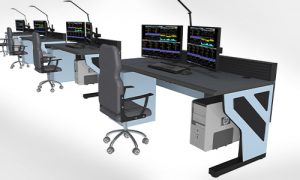
While control room consoles are typically selected based on ergonomics, equipment capacity, and operational functionality, they significantly influence acoustic performance through multiple mechanisms that designers often overlook. The furniture surrounding operators affects how sound propagates through spaces, whether equipment noise reaches operators directly, and how speech communications behave between positions.
Equipment Noise Isolation Through Console Design
Console furniture with enclosed or semi-enclosed equipment bays provides acoustic benefits by containing equipment noise within structures that attenuate sound transmission to operator positions. Computers, servers, networking equipment, and other noise-generating devices housed in console equipment bays with solid or acoustically-treated panels transmit less noise to operators than equipment in open racks or on work surfaces. The degree of acoustic isolation depends on enclosure construction—simple panel enclosures might provide 3-6 dB noise reduction, while acoustically-treated enclosures can achieve 10-15 dB reductions.
However, equipment enclosures must balance acoustic isolation with thermal management. Sealed enclosures that effectively contain noise also trap heat, potentially creating thermal problems and forcing cooling fans to operate at higher speeds, generating more noise than the enclosure attenuates. Effective acoustic console design incorporates ventilation that enables adequate equipment cooling while maintaining acoustic performance—using baffled openings, indirect airflow pathways, or acoustic foam maintaining airflow while absorbing sound.
Workstation Screening and Sound Propagation
Console height, equipment section profiles, and overall geometry influence how sound propagates between operator positions. Low-profile open consoles provide excellent visibility and communication pathways but offer minimal acoustic separation between operators. Taller consoles with raised equipment sections or integrated screens provide partial barriers, reducing sound transmission between positions without completely isolating operators. The optimal approach depends on operational requirements—some operations benefit from minimal barriers that enable easy verbal communication, while others require acoustic separation to support concentration.
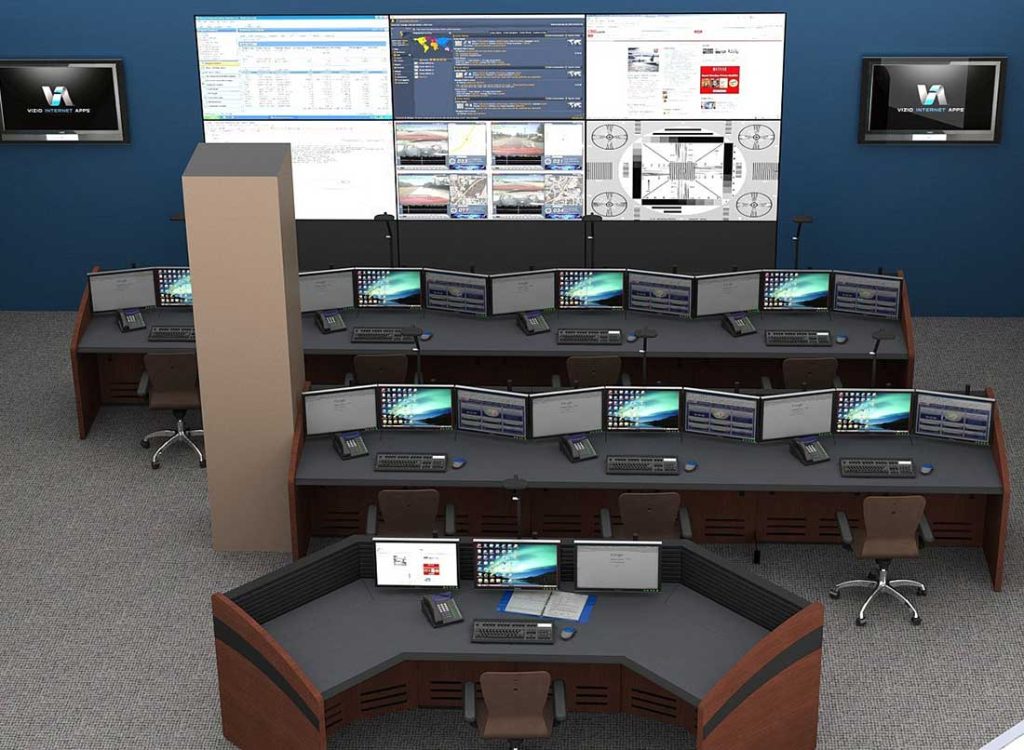
Console arrangements in rows versus clusters, curved layouts versus straight configurations, and spacing between positions all affect acoustic performance. Straight, parallel console rows with narrow spacing create sound channels in which noise propagates efficiently along the rows. Curved arrangements or angled orientations break up these acoustic pathways, potentially reducing sound transmission. However, these same curved layouts might reflect sound back toward positions in ways that increase perceived noise levels. Acoustic modeling during design phases helps optimize layouts for specific operational and acoustic requirements.
Material Selection and Vibration Damping
Console construction materials and structural design influence both direct acoustic transmission and vibration-related noise. Metal construction—common in professional control room furniture—provides excellent structural strength but can transmit vibration and resonate at certain frequencies if not properly damped. Wood or composite materials typically provide better intrinsic vibration damping but may lack the structural capacity required for equipment-intensive applications.
Quality console designs incorporate vibration isolation between equipment mounting points and console structures, damping materials in panel assemblies, and construction techniques minimizing resonance at frequencies where equipment or building vibration commonly occurs. These acoustic considerations often remain invisible in finished furniture but meaningfully impact operational noise levels and equipment-generated vibration reaching operators.
Industry Insight: When specifying console furniture for acoustically-sensitive control rooms, request acoustic performance data from manufacturers, including equipment noise attenuation measurements, vibration isolation characteristics, and materials specifications for acoustic properties. Quality manufacturers familiar with mission-critical applications can provide this information and discuss acoustic considerations during design, while generic office furniture vendors often lack relevant expertise or data.
Acoustic Treatment Strategies for Control Room Environments
Beyond console furniture, comprehensive acoustic design employs multiple treatment strategies addressing different acoustic challenges through complementary approaches. The most effective implementations layer multiple solutions rather than relying on single interventions.
Absorption Materials and Surface Treatments
Acoustic absorption materials reduce sound reflection and reverberation by converting acoustic energy into small amounts of heat through friction in porous materials or membrane vibration. Common absorption treatments in control rooms include acoustic ceiling tiles or panels, wall-mounted absorptive panels, fabric-wrapped fiberglass or mineral wool treatments, and specialized acoustic foam products designed for specific frequency ranges.
Absorption effectiveness varies by frequency, with most common materials performing best at mid-to-high frequencies (500-4,000 Hz) where speech occurs, but providing limited absorption at low frequencies (below 250 Hz) where equipment hum and HVAC noise dominate. Addressing low-frequency noise often requires thicker absorption materials, bass traps, or resonant absorbers specifically designed for those frequencies. The amount and placement of absorption materials influences reverberation time and overall acoustic character—too little absorption creates excessive reverberation and noise buildup, while excessive absorption makes spaces feel acoustically “dead” and can paradoxically reduce speech intelligibility.
Acoustic Barriers and Sound Isolation
Where absorption addresses sound within spaces, barriers prevent sound transmission between spaces or from external sources. Effective acoustic barriers typically employ mass, isolation, or both. Heavy, dense materials like concrete, gypsum board, or mass-loaded vinyl provide sound blocking through sheer mass—sound energy cannot easily vibrate heavy materials. Isolation decouples structures so that vibration cannot transmit from the source to the receiver—floating floors, isolated walls, and resilient mounting systems prevent structural sound transmission.
Control rooms in buildings shared with other activities often require acoustic barriers to protect from external noise. Conference rooms, mechanical rooms, and building circulation spaces adjacent to control rooms can transmit substantial noise through shared walls if barriers are inadequate. Proper barrier design addresses both direct transmission through barrier materials and flanking pathways where sound bypasses barriers through shared structural elements, ceiling plenums, or penetrations for building systems.
HVAC System Acoustic Design
HVAC systems represent such significant noise sources that addressing them requires dedicated acoustic strategies beyond general treatments. HVAC acoustic design might include equipment selection prioritizing quiet operation, sound attenuators in ductwork to absorb noise before it reaches occupied spaces, proper duct sizing, maintaining air velocities below noise-generating thresholds, and isolated equipment mounting to prevent vibration transmission through structures.
Diffuser selection and placement significantly impact perceived noise in control rooms. High-induction diffusers, low-velocity displacement ventilation, or specialized low-noise diffuser designs maintain the required airflow while reducing turbulence noise compared to standard diffusers. However, these solutions often cost more and may occupy more ceiling space than conventional approaches, creating tradeoffs between acoustic performance and project budgets or architectural constraints.
Coordinating Acoustics with Operational Requirements
Effective control room acoustic design must balance multiple operational requirements that can conflict with acoustic objectives. Understanding these trade-offs and finding solutions that satisfy both acoustic and operational needs separates successful implementations from projects that achieve acoustic targets while creating operational problems, or from projects that optimize operations while accepting acoustic compromises that degrade performance.
Balancing Communication Needs with Noise Control
Control rooms require both acoustic isolation, enabling concentration, and acoustic openness, enabling communication. Operators need to communicate verbally with teammates during coordination activities, but excessive chatter can distract from monitoring tasks that require sustained attention. Supervisors need awareness of operator communications, without those conversations creating noise affecting other operators.
Acoustic zoning approaches create regions within facilities optimized for different activities. Analytical monitoring positions requiring sustained concentration might be located in acoustically-isolated areas with greater absorption and barriers to reduce distraction. Coordination or dispatch positions with intensive verbal communication might be grouped together when their activities don’t impact analytical work. Supervisory positions might be positioned acoustically between zones, maintaining awareness of multiple areas while not being overwhelmed by any single area’s noise.
Technology Integration and Acoustic Performance
Communications equipment, audio systems, and alert mechanisms must function effectively within the acoustic environments they also contribute to. Headset use reduces the acoustic impact of radio and telephone communications but creates ergonomic challenges during extended shifts and can isolate operators from ambient awareness, which is valuable for coordination. Speaker-based communications enable ambient awareness but contribute to background noise and privacy concerns.
Modern audio technologies, including directional speakers, localized sound masking, and adaptive volume systems, enable more sophisticated approaches. Directional speakers deliver audio primarily to intended operators with reduced spillover to adjacent positions. Adaptive volume systems automatically adjust based on measured background noise, maintaining audibility without operating at unnecessarily high volumes during quiet periods. However, these advanced systems add cost and complexity, requiring an evaluation of whether their benefits justify incremental investment for specific applications.
Key Consideration: Organizations should avoid acoustic perfectionism that creates operational problems in pursuit of ideal noise levels. A facility maintaining 32 dB background noise through excessive acoustic isolation that hinders necessary verbal communication serves operations less effectively than one accepting 40 dB while enabling efficient coordination. The goal is acoustic performance supporting mission effectiveness, not achieving acoustic metrics as ends in themselves.
Testing, Validation, and Ongoing Acoustic Management
Even carefully designed acoustic environments require validation to ensure actual performance matches design intent, and ongoing management to maintain acoustic quality throughout facility lifespans. Several approaches support these objectives:
Commissioning and Acoustic Verification
Professional acoustic measurements following the completion of the control room validate that the implemented designs achieve the target performance. These measurements should be conducted with HVAC systems operating at design conditions, representative equipment loads energized, and across various operational configurations to ensure acoustic performance holds across realistic operating scenarios. Measurements taken in empty, silent facilities might show excellent results that don’t reflect actual operational conditions when equipment operates and personnel are present.
Acoustic commissioning often reveals issues requiring adjustment before facilities become fully operational. HVAC systems might generate unexpected noise requiring additional sound attenuators. Equipment placement might create acoustic problems not apparent in design models. Reverberation characteristics might differ from predictions, requiring adjustment to absorption treatments. Identifying and correcting these issues during commissioning prevents them from degrading operational performance and creating expensive retrofits after facilities enter service.
Ongoing Acoustic Maintenance
Acoustic performance can degrade over time through multiple mechanisms. Acoustic materials deteriorate, particularly ceiling tiles and fabric-wrapped panels exposed to dust, humidity, or physical damage. HVAC system performance changes as filters clog, bearing wear increases, or equipment ages, often manifesting as increased noise. Equipment malfunctions begin with subtle acoustic changes—failing fans, worn bearings, or thermal stress—that careful attention can identify before they lead to failure.
Establishing acoustic performance baselines and conducting periodic reassessments helps identify degradation before it significantly impacts operations. These assessments might occur annually or following major facility changes, equipment upgrades, or organizational feedback suggesting acoustic problems are emerging. Early intervention to address acoustic degradation typically costs far less than allowing problems to accumulate and requiring comprehensive remediation.
Frequently Asked Questions About Control Room Acoustics
How much should organizations budget for acoustic treatments in control room projects?
Acoustic treatments typically represent 2-5% of total control room project budgets for new construction, potentially reaching 8-12% for renovations of existing spaces with poor baseline acoustics. A $500,000 control room project might allocate $10,000-25,000 for acoustic treatments, such as ceiling and wall absorbers, HVAC sound attenuators, and acoustic consultation. While this might seem substantial, proper acoustic design costs far less than the productivity losses from poor acoustics or the expensive retrofits required to fix acoustic problems in completed facilities.
Can acoustic problems in existing control rooms be fixed without major renovations?
Many acoustic issues can be improved through targeted interventions, including adding ceiling tiles or wall panels to provide sound absorption, installing sound attenuators in HVAC ductwork, relocating particularly noisy equipment, adjusting HVAC operation for quieter performance, or modifying console layouts to separate noise-sensitive positions from noise sources. However, fundamental problems like inadequate sound isolation from external sources or structural noise transmission often require more extensive interventions. Professional acoustic assessment identifies which problems can be addressed through modest retrofits versus those requiring major work.
How do we measure control room noise levels to know if we have problems?
Professional sound level meters measuring A-weighted sound pressure levels (dBA) over time provide accurate baseline data. Measurements should be taken at operator positions under typical operational conditions, not in empty, quiet rooms. Many organizations discover that their subjective sense of whether facilities are “noisy” or “quiet” doesn’t match objective measurements—some facilities feel uncomfortable but acoustically measure acceptably, while others seem fine but show problematic noise levels. Professional acoustic consultants can conduct comprehensive assessments, including frequency analysis, reverberation measurements, and speech intelligibility testing, providing complete acoustic characterization.
Conclusion: Integrating Acoustics into Comprehensive Control Room Design
Acoustic performance in control rooms directly enables or constrains human performance, determining mission success. Operators struggling with excessive background noise, unclear communications, or acoustic fatigue cannot maintain the sustained concentration and rapid response that mission-critical operations demand. Yet acoustic considerations too often receive inadequate attention during control room planning, treated as refinements to be addressed if budgets permit rather than fundamental requirements deserving priority alongside ergonomics, technology, and operations planning.
Successful acoustic design requires integrated approaches that address room design, console furniture selection, surface treatments, and HVAC coordination together, rather than treating these as independent elements. Organizations planning control room facilities should establish acoustic performance targets during initial design phases, validate proposed designs through acoustic modeling, and verify actual performance through commissioning measurements. This systematic approach costs less than retrofitting to address acoustic issues while ensuring operators work in environments that support sustained high performance throughout extended shifts and lengthy careers.
The investment in proper acoustic design typically accounts for 2-5% of total control room project budgets, yet it influences 100% of the operator experience and performance. Organizations that continue to underinvest in acoustics discover that the performance losses, operator dissatisfaction, and eventual retrofits cost far more than an appropriate acoustic design would have initially. As control rooms evolve toward more sophisticated operations supporting increasingly complex missions, acoustic quality must evolve from a nice-to-have refinement to an essential infrastructure supporting operational excellence.
For more information on control room design that integrates acoustic performance with ergonomics and operational effectiveness, contact Command Watch.
Contact Information:
(866) 740-2121
cwsales@command-watch.com