How AI-Driven Cooling Technology Is Transforming Mission-Critical Control Rooms

Jump to a Section
Your essential guide to understanding how artificial intelligence and advanced thermal management are reshaping control room design, protecting critical equipment, supporting operator performance, and reducing energy costs in 24/7 mission-critical facilities.
TL;DR – Quick Takeaways
Mission-critical control rooms face escalating thermal management challenges as equipment density increases, AI workloads proliferate, and operational demands intensify. Modern facilities housing network operations, emergency dispatch, military command, and industrial monitoring now generate heat loads comparable to those of traditional data centers—yet this equipment operates within occupied workspaces, where operators must maintain peak performance throughout extended shifts. Traditional HVAC approaches that rely on facility-wide temperature control and reactive cooling adjustments are increasingly inadequate, leading to simultaneous over-cooling that wastes energy and hot spots that threaten equipment reliability.
Artificial intelligence transforms thermal management by enabling real-time monitoring, predictive adjustments, and precisely targeted cooling delivery matched to actual requirements rather than broad facility averages. When integrated with properly designed console furniture featuring engineered airflow, equipment ventilation, and thermal-aware construction, intelligent cooling systems reduce energy consumption by 20-40% while improving equipment reliability and operator comfort. Organizations modernizing control rooms must view thermal management as an integrated design element alongside console selection and technology infrastructure, rather than treating cooling as a separate facility concern addressed independently.
The convergence of intelligent cooling technology, liquid cooling integration for high-density equipment, and thermally-optimized console furniture creates opportunities for facilities to support efficient operations, accommodate technology evolution, and demonstrate environmental responsibility. Success requires systematic approaches that begin with a comprehensive thermal assessment, progress through phased implementation, build stakeholder confidence, and deliver meaningful benefits while minimizing deployment risk.
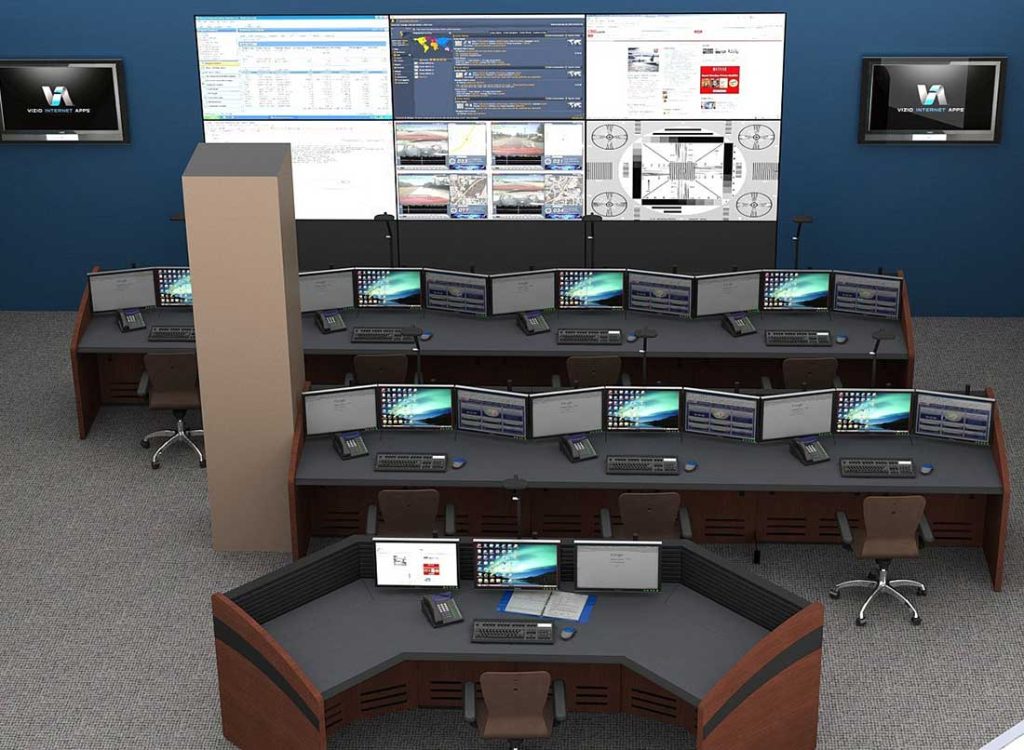
In mission-critical control rooms, thermal management is not just a facility concern—it directly impacts operator comfort, equipment reliability, and long-term console performance. As control room consoles house increasingly dense computing and display systems, intelligent cooling must be considered alongside furniture design and layout planning.
Understanding the Modern Control Room Thermal Challenge
Control room technology has transformed dramatically over the past decade. Where operators once monitored systems using dedicated terminals that generated modest heat, today’s workstations integrate high-performance computing, GPU-accelerated graphics driving multi-monitor arrays, network equipment supporting bandwidth-intensive applications, and AI platforms that run continuously. This evolution fundamentally changes thermal dynamics within facilities, creating heat management challenges that traditional HVAC systems weren’t designed to address.
The problem intensifies as organizations adopt artificial intelligence for operational analytics, predictive monitoring, and automated decision support. AI workloads impose sustained, high-utilization loads on processors, generating continuous thermal output far exceeding that of traditional monitoring applications. A single AI-powered video analytics system can generate more heat than an entire legacy operator position. When multiplied across 10-20 workstations, cumulative thermal loads approach data center levels—yet this heat is generated within occupied workspaces, where operators must remain comfortable throughout 8-12 hour shifts.
Control rooms present fundamentally different thermal challenges than data centers despite similar equipment densities. Occupied workspace integration means cooling systems must simultaneously address equipment heat loads and human comfort requirements. Variable heat loads throughout operational cycles create challenges for static cooling systems. Equipment proximity to operators places heat-generating devices within the immediate workspace rather than isolated rooms. Airflow constraints from console furniture and cable management interfere with cooling distribution. Acoustic sensitivity prevents high-velocity air distribution, creating distracting noise.
Strategic Move: Organizations planning control room facilities or technology upgrades should conduct a thermal load analysis early in the design process, quantifying expected heat generation from planned equipment and comparing it against existing HVAC capacity. Many facilities discover that adding modern displays, upgraded workstations, or AI platforms will exceed cooling capacity, requiring HVAC upgrades, influencing console placement, and facility design.
Why Traditional Cooling Approaches Fall Short
Conventional HVAC systems designed for general commercial occupancy feature central air handlers distributing conditioned air through ductwork, with thermostats controlling temperature based on measurements at one or a few locations. This approach works adequately for normal offices where heat loads are distributed evenly, and temperature requirements aren’t demanding. However, it proves increasingly inadequate for modern control rooms.
Single-point control based on wall-mounted thermostats makes cooling decisions for entire facilities. If thermostats are located away from equipment concentrations, HVAC may not provide adequate cooling to equipment-dense areas. Conversely, thermostats near equipment clusters might trigger excessive cooling across the facility, wasting energy. Slow response times—taking 15-30 minutes to adjust—create periods of elevated temperatures when heat spikes occur rapidly. Lack of granularity means entire zones receive identical cooling regardless of local needs, simultaneously over-cooling some areas while under-cooling others.
Faced with inadequate control and slow response, facilities typically adopt defensive over-cooling strategies: maintaining entire facilities at lower temperatures than necessary to ensure equipment areas receive adequate cooling. This defensive approach creates substantial costs. Energy waste from cooling spaces below required temperatures typically accounts for 30-50% of HVAC costs. Equipment wear from continuous over-capacity operation reduces system lifespans. Operator discomfort from excessive cooling ironically degrades the human performance that control rooms exist to support.
The Role of Artificial Intelligence in Cooling Optimization
AI transforms thermal management by enabling real-time monitoring, predictive adjustments, and precisely targeted cooling delivery. Rather than replacing cooling hardware, AI augments systems with intelligence, enabling dynamic, predictive operation matched to actual requirements.
The foundation begins with comprehensive thermal monitoring. IoT sensor networks distribute wireless temperature and humidity sensors at strategic locations—near operator positions, within console equipment bays, and behind display arrays. These sensors report continuously, creating detailed thermal maps rather than the single-point measurements conventional thermostats provide.
Machine learning algorithms analyze patterns in monitoring data, identifying relationships between equipment operation, facility occupancy, time of day, outdoor conditions, and resulting heat loads. Over time, AI systems develop a sophisticated understanding of facility thermal behavior, enabling intelligent decisions. Establishing baselines by analyzing operational data enables systems to distinguish normal variations from genuine anomalies. Correlation analysis identifies cause-and-effect patterns enabling predictive adjustments. Anomaly detection automatically identifies unusual thermal patterns indicating developing problems.
Beyond monitoring and analysis, AI systems integrate with HVAC controls to implement autonomous cooling adjustments based on real-time conditions and predictive modeling. Demand-responsive cooling adjusts output dynamically based on measured and predicted loads rather than fixed schedules. Predictive precooling anticipates increases in thermal load, ramping up capacity before temperature spikes occur. Zoned optimization delivers precisely calibrated cooling to different areas based on specific requirements. Failure compensation enables automatic adjustments when components fail, maintaining adequate cooling until maintenance corrects underlying issues.
Pro Tip: Organizations implementing AI cooling should plan for 6-12 month learning periods during which systems gather operational data and develop thermal models. Initial deployments often operate in monitoring mode with limited autonomous control while building confidence in system recommendations. As AI models demonstrate reliable performance, organizations gradually expand their authority over autonomous control.
Integrating Thermal Management with Console Furniture Design
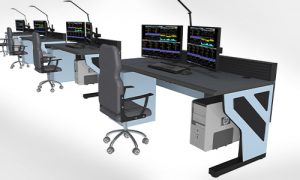
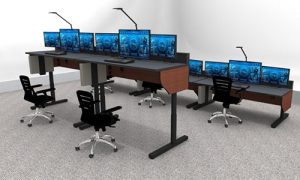
While intelligent cooling systems receive significant attention, the fundamental role of control room consoles in thermal management often goes underappreciated. Console furniture directly influences airflow patterns, equipment ventilation, heat concentration, and overall thermal dynamics within operator workspaces. Effective thermal management requires integrating console design with cooling system planning.
Equipment housing configuration determines whether heat-generating devices receive adequate ventilation or accumulate heat within enclosed spaces. Consoles with sealed equipment bays lacking ventilation can create hot spots where computers and power supplies generate heat faster than it dissipates. Conversely, designs incorporating ventilation perforations, open equipment areas, or engineered airflow channels enable natural convection and assist active cooling. Structural materials influence thermal handling—metal construction conducts heat away from devices and dissipates it across larger areas, while composite materials have lower thermal conductivity, potentially allowing heat to concentrate.
Cable management systems affect airflow through workspaces. Poorly organized cabling creates obstructions that block airflow, prevent cooling air from reaching equipment, and trap heat. Quality console furniture solutions with comprehensive cable management keep cabling contained and out of airflow pathways, enabling effective cooling distribution. Work surface geometry and spacing influence air circulation around operator positions. Designs with adequate clearances enable air movement, assisting cooling, while tightly-packed consoles with minimal spacing restrict airflow, creating dead zones.
Professional control room furniture incorporates features specifically designed to support thermal management. Ventilation perforations in equipment bay panels enable air circulation through console structures. Equipment bay organization with internal mounting structures maintains airflow clearances. Thermal-aware cable routing designs pathways considering their impact on airflow. Service access panels enable equipment maintenance without extensive disassembly, supporting regular cleaning necessary for sustained cooling effectiveness. Ergonomic workstations with height adjustment must account for cable flexibility and ensure effective ventilation throughout the adjustment range.
Organizations planning facilities should integrate console furniture decisions with thermal management planning. Early thermal load assessment quantifying expected heat generation informs both console selection and HVAC sizing. Airflow modeling during design can simulate how console arrangements interact with HVAC configurations. Console specifications should explicitly address thermal requirements, including ventilation provisions and airflow in the equipment bay. Integrated installation, including console placement, HVAC commissioning, and equipment installation, ensures all elements work together effectively.
Operator Comfort and Performance Benefits
While equipment protection is a focus of cooling discussions, the impact on operator comfort and performance is an equally important consideration. Operators are the reason control rooms exist—facilities exist to support human decision-making and coordinated response. Environmental conditions that degrade operator comfort or cognitive performance undermine mission effectiveness, regardless of equipment protection.
Extensive research demonstrates clear relationships between thermal comfort and cognitive performance. Operators working outside their comfort range—typically 68-72°F—experience measurable performance degradation. Cognitive processing speed declines in both overly warm and excessively cold environments, with reaction times increasing 5-10% beyond comfortable ranges. Sustained attention declines particularly in warm environments, with operators showing shorter attention spans and higher error rates as temperatures rise. Complex problem-solving abilities degrade as cognitive resources are diverted to coping with discomfort rather than to operational decisions.
AI-powered adaptive cooling delivers operator benefits beyond equipment protection. Personalized thermal zones enabled by granular control can accommodate individual preferences. Dynamic adjustment throughout shifts maintains optimal conditions as thermal loads vary with operational tempo. Reduced acoustic disturbance from unnecessary cooling fan operation improves concentration. Stable conditions without temperature swings prevent discomfort from alternating between feeling cold and warm.
Industry Insight: Leading control room operators now consider thermal comfort an explicit design objective rather than simply a byproduct of equipment cooling. Design specifications state operator position target temperatures, acceptable variation ranges, and performance standards for maintaining stable conditions throughout shifts. This operator-centric approach recognizes that equipment protection and human performance both require appropriate environmental conditions.
Energy Efficiency and ROI Considerations
Control rooms operate continuously, with HVAC representing 30-50% of energy consumption. In large facilities supporting 15-20 operator positions, annual energy costs easily reach $100,000-300,000, making cooling optimization a significant opportunity for cost reduction and environmental responsibility.
Organizations implementing AI-powered adaptive cooling typically achieve 20-40% reductions in HVAC energy consumption. Eliminating over-cooling accounts for the largest savings component—conventional systems maintained 2-5°F below required temperatures waste substantial energy. Dynamic capacity modulation, matching output to actual loads, reduces consumption during lower-demand periods. Predictive load management enables more efficient operation by allowing gradual capacity ramping rather than emergency cooling responses. Reduced equipment wear extends maintenance intervals and delays capital replacement.
The economics generally prove attractive despite the upfront investment. A typical implementation for a 15-position control room might cost $75,000-150,000, including sensor infrastructure, control systems, HVAC integration, and commissioning. For facilities with $60,000 annual HVAC costs, a 30% reduction saves $18,000 annually. Over 10 years, cumulative savings exceed $180,000—substantially more than the initial investment. When evaluating ROI, organizations should consider direct energy reductions, reduced maintenance, extended equipment lifespans, fewer equipment failures, and improved operator productivity.
Beyond economics, optimized cooling supports organizational sustainability objectives. A 30% reduction in HVAC energy translates directly to reduced carbon emissions. For facilities in regions with carbon-intensive electricity generation, HVAC optimization can reduce the annual carbon footprint by tens of tons of CO2-equivalent. Organizations with sustainability reporting requirements can quantify and claim these benefits in environmental disclosures.
The Role of Liquid Cooling for High-Density Equipment
While air cooling dominates control room thermal management, liquid cooling technology is beginning to appear in mission-critical environments as equipment heat density exceeds air-cooling capabilities. Liquid cooling leverages water or specialized coolants’ superior thermal transfer properties—water has roughly 25 times the heat capacity of air per unit volume, enabling much more efficient heat removal.
Liquid cooling applications in control rooms typically supplement air cooling for specific high-heat equipment. Server and computing equipment driving intensive workloads—particularly GPU-accelerated systems running AI analytics—often warrant liquid cooling when heat output exceeds the practical capacity of air cooling. Display wall systems using high-brightness LED panels generate substantial heat that liquid cooling can remove efficiently, without the need for loud fans. Enclosed equipment racks within console furniture benefit from liquid cooling when ventilation restrictions prevent adequate air cooling.
However, liquid cooling presents challenges limiting adoption. Infrastructure requirements, including chilled water systems and coolant distribution piping, add complexity beyond air cooling. Leak risk creates concerns in environments housing sensitive electronics. Maintenance complexity increases compared to air cooling. Vendor and equipment compatibility limitations mean liquid cooling requires specific equipment variants. For most control room applications, liquid cooling remains a specialized solution for specific high-heat equipment rather than a comprehensive facility-wide approach.
Implementation Best Practices
Organizations convinced of the benefits of intelligent cooling face practical questions about initiating implementation. Several principles guide successful deployments:
Start with a comprehensive assessment of current thermal performance, using direct measurements at multiple locations over representative time periods. Inventory equipment, heat loads, and expected future additions. Evaluate HVAC system capacity and condition. Analyze airflow patterns using thermal imaging or smoke testing. Gather operator comfort feedback about current conditions. This assessment establishes a baseline understanding that informs implementation planning.
Select appropriate technology solutions, evaluating sensor infrastructure requirements, control system architectures, machine learning sophistication, and vendor viability. Consider whether standalone dedicated systems or integration with existing HVAC controls better suit organizational needs. Evaluate vendors’ track records and support capabilities, ensuring successful implementation and ongoing assistance.
Implement in phases rather than attempting comprehensive facility-wide deployment immediately. Phase 1 focuses on monitoring and analysis, gathering operational data, and building thermal models while the existing HVAC continues operating. Phase 2 enables limited autonomous control within constrained parameters while monitoring results. Phase 3 expands autonomous operation as systems demonstrate reliable performance. Phase 4 involves continuous optimization and ongoing refinement. This phased approach reduces risk, builds confidence progressively, and enables learning from early phases.
Key Consideration: Organizations should view intelligent cooling as continuously improving rather than static once deployed. As systems learn from additional operational data, operators provide feedback, and vendors release capability improvements, thermal management effectiveness will increase throughout the facility’s lifespan.
Looking Forward: Future Trends in Control Room Thermal Management
Several emerging trends will shape how organizations approach environmental control in the coming years. Integration with broader facility management will create comprehensive platforms that integrate cooling optimization with lighting control, power distribution, equipment monitoring, and security systems. This holistic optimization considers interactions between systems rather than optimizing each independently.
Equipment and console furniture co-design will see closer collaboration between furniture manufacturers, computing equipment vendors, and cooling system developers. Future console designs might integrate sophisticated thermal capabilities, including embedded sensors, active cooling systems built into furniture, and smart power-distribution monitoring of loads and heat generation. Computing equipment might incorporate enhanced telemetry reporting of thermal conditions to facility management systems.
Artificial intelligence maturity will bring capability improvements as systems analyze years rather than months of data, developing a more nuanced understanding of thermal dynamics. Cross-facility learning, where AI systems share insights across multiple installations, could enable each facility to benefit from patterns identified in others.
Predictive maintenance capabilities, which identify and develop problems through thermal anomaly patterns, will help organizations transition from reactive repairs to proactive prevention.
As intelligent building systems become more common, expect industry standards and potentially regulatory requirements addressing their design and operation. Industrial control rooms serving critical infrastructure might face specific requirements to ensure that intelligent systems cannot compromise operations through failure modes or vulnerabilities. These potential requirements should inform current deployment decisions.
Conclusion: Embracing Intelligent Thermal Management
The convergence of increasing equipment heat density, AI workload adoption, and intelligent cooling technology creates both challenges and opportunities for organizations operating mission-critical control rooms. Traditional thermal management approaches prove increasingly inadequate as equipment evolves and operational requirements intensify.
Organizations continuing to rely on conventional strategies will face escalating problems, including reliability issues, uncomfortable environments, constrained capacity, and excessive energy costs.
Organizations embracing intelligent thermal management through AI-powered cooling, thermally-aware console design, and integrated facility planning position themselves for sustained operational excellence. Benefits extend beyond maintaining acceptable temperatures to encompass substantial energy cost reduction, improved equipment reliability, enhanced operator comfort and performance, increased facility flexibility, and demonstrated environmental stewardship.
Implementation doesn’t require massive upfront investments or facility-wide transformation. Organizations can begin with a comprehensive thermal assessment, proceed through phased deployment, building confidence progressively, and achieve meaningful benefits while minimizing risk. Economic returns typically justify investments within 2-4 years through energy savings alone, with additional benefits from improved reliability and operator performance.
As control room technology continues to evolve, thermal management will increasingly differentiate facilities that support effective mission performance from those that struggle with environmental constraints. The mission-critical operations your control room supports deserve infrastructure that enables, rather than constrains, performance. Intelligent thermal management provides that foundation while delivering economic and environmental benefits justifying investment independent of operational improvements.
For help designing modern control room layouts optimized for thermal management or evaluating console furniture supporting efficient cooling, contact Command Watch at 800-346-7521 or cwsales@command-watch.com.
Recommended Insight:
How to Select Control Room Consoles
Discover the key factors—ergonomics, modularity, and technology integration—that impact long-term operator performance.