SCIF Control Room Design: Securing Sensitive Operations Without Sacrificing Performance

TL;DR – Quick Summary
- Topic Overview: A comprehensive guide to designing SCIF-enabled control rooms that protect classified operations while supporting 24/7 mission performance, operator ergonomics, secure infrastructure integration, and long-term accreditation compliance.
- Key Insights: Modern SCIFs increasingly operate as fully staffed command environments, relying on purpose-built control room consoles that support secure communications, continuous monitoring, and sustained operator performance. Effective SCIF control room design requires integrated planning across console furniture, RF and acoustic shielding, cable management, thermal control, ergonomics, and security accreditation—rather than treating security and operations as separate concerns.
- Who This Is For: Government agencies, military organizations, intelligence teams, secure network operations centers, architects, facility planners, and program managers responsible for planning or upgrading SCIF control rooms, command centers, or classified operations environments.
- Action Step: Engage SCIF-experienced design and console furniture specialists early in the planning process to align security requirements, infrastructure constraints, and operator performance needs—reducing accreditation risk, avoiding costly retrofits, and ensuring long-term operational effectiveness.
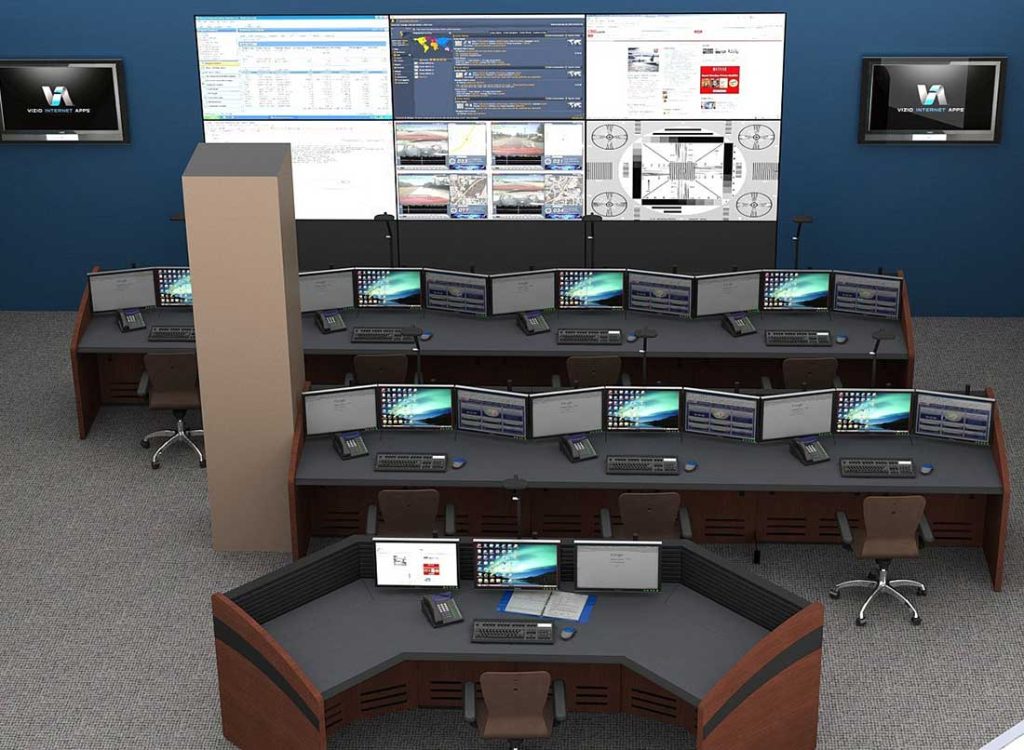
Designing a Sensitive Compartmented Information Facility (SCIF) is no longer limited to secure briefing rooms or intelligence conference spaces. Today, many SCIFs function as fully operational control rooms and command centers, supporting 24/7 monitoring, analysis, and decision-making in environments where security and human performance are equally mission-critical.
These facilities must protect classified information from physical, acoustic, and electromagnetic threats—while also enabling operators to work long shifts surrounded by high-performance technology. Achieving that balance requires more than security hardening alone. It demands an integrated control room design in which console furniture, infrastructure, environmental systems, and accreditation requirements are planned together from the start.
This guide explains how SCIF requirements affect control room layout, console furniture selection, cable management, shielding, ergonomics, and long-term operational reliability—and what organizations should consider when planning secure, high-performance command environments.
What Is a SCIF in a Control Room Context?
A Sensitive Compartmented Information Facility (SCIF) is a secure environment built to U.S. government standards to prevent unauthorized access, surveillance, and data interception. SCIFs protect Sensitive Compartmented Information (SCI)—classified intelligence sources, methods, and operational data that require safeguards beyond conventional classified handling.
While SCIFs are often associated with meeting rooms or analysis spaces, many are purpose-built around active control rooms, including:
- Military command and intelligence centers
- Secure network operations centers (NOCs)
- Federal and government agency operations rooms
- Emergency and continuity-of-operations command facilities
Unlike conference SCIFs, used intermittently, operational SCIF control rooms must support:
- Continuous staffing and 24/7 operations
- Dense computing, communications, and display systems
- Extended operator shifts under high cognitive load
- Reliable environmental control within sealed, shielded spaces
These requirements significantly complicate design decisions—especially when security, infrastructure, and ergonomics are treated as separate concerns.
Common Applications for SCIF-Enabled Control Rooms
SCIF control rooms support a wide range of mission-critical functions:
Military and Intelligence Command Centers
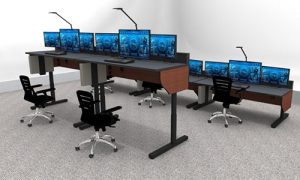
These facilities coordinate forces, analyze intelligence feeds, and maintain situational awareness across multiple domains. Operators rely on multi-monitor workstations, secure communications, and real-time data visualization—often operating continuously.
Government and Federal Agency Operations Rooms
Law enforcement, counterintelligence, and emergency management organizations use SCIFs to manage sensitive operations where classified data informs time-critical decisions.
Secure Network Operations Centers
Classified NOCs monitor protected networks, cybersecurity threats, and infrastructure supporting sensitive communications. Technology density in these environments often exceeds conventional NOCs due to layered security systems and redundancy.
Continuity-of-Operations and Crisis Command Facilities
Some SCIFs remain dormant until activated during emergencies, while others support daily operations with surge capacity. In both cases, rapid readiness and ergonomic effectiveness are essential.
Core SCIF Requirements That Impact Control Room Design
SCIF standards are governed by strict federal requirements addressing physical, technical, and acoustic security. These requirements are outlined and overseen by the Office of the Director of National Intelligence (ODNI).
You can reference official guidance at:
https://www.dni.gov/
While full SCIF specifications are extensive, several core requirements directly influence control room layout and secure console furniture design.
RF and Electromagnetic Shielding Considerations
Modern control rooms generate significant electromagnetic emissions from:
- Displays and video walls
- Computing hardware and GPUs
- Network switches and power supplies
- Signal-carrying cables
SCIF construction incorporates shielding within walls, ceilings, floors, doors, and penetrations to prevent these emissions from leaking outside secure boundaries.
Design implications include:
- Equipment placement must avoid concentrating high-emission devices near potential shielding weaknesses
- Cabling must remain shielded throughout its entire routing path
- Console furniture must accommodate shielded cables without creating gaps in protection
- Ventilation pathways must preserve shielding integrity while allowing adequate cooling
Console systems constructed with steel frames and integrated cable management help support shielding continuity when properly bonded to facility grounding systems.
Acoustic Security and Operator Focus
Acoustic eavesdropping is another critical threat. SCIFs employ sound-absorbing construction, white-noise masking, and elimination of acoustic pathways to prevent conversations and equipment sounds from being intercepted.
At the same time, operators require quiet, controlled environments to maintain concentration.
Effective SCIF control room design balances both needs by:
- Using acoustic treatments that reduce reverberation without excessive noise
- Limiting fan and equipment noise through enclosed equipment bays
- Separating communication-heavy positions from analytical workstations
- Designing console layouts that minimize sound transmission between operators
Poor acoustic planning can degrade operator performance even when security objectives are met.
Visual Security and Physical Access Control
SCIFs typically eliminate exterior windows to prevent visual surveillance and reduce electromagnetic leakage. Physical access is tightly controlled using layered authentication, intrusion detection, and visitor management protocols.
For control rooms, this affects:
- Placement of video walls and displays relative to entry points
- Console orientation to prevent exposure during door openings
- Emergency egress design that maintains security integrity
- Visibility of indicator lights and status displays
These considerations should be addressed early in layout planning to avoid costly redesigns during accreditation.
Infrastructure Challenges in SCIF Control Rooms
SCIF infrastructure must support operations while maintaining security:
- Power systems require proper grounding and filtering
- HVAC systems must penetrate shielded boundaries without compromising security
- Communications networks often require physical separation between classification levels
Console furniture must integrate seamlessly with these systems, accommodating secured power distribution, shielded cabling, and classified equipment handling procedures.
The Critical Role of Console Furniture in SCIF Control Rooms
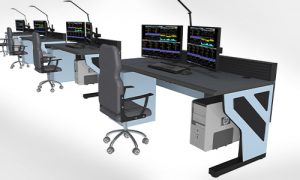
In SCIF environments, console furniture is not just workspace—it is part of the security and operational infrastructure.
Well-designed console systems support:
- Secure equipment housing
- Shielded and organized cable routing
- Thermal management in sealed environments
- Ergonomic performance for extended shifts
- Maintenance and upgrades without compromising accreditation
Generic commercial furniture often fails to meet these requirements.
SCIF-Ready Console Furniture Checklist
When specifying console furniture for SCIF control rooms, look for systems that provide:
- Lockable equipment bays for classified hardware
- Shielded cable raceways supporting classification separation
- Steel or metal construction compatible with RF shielding plans
- Ventilated equipment bays designed for sealed environments
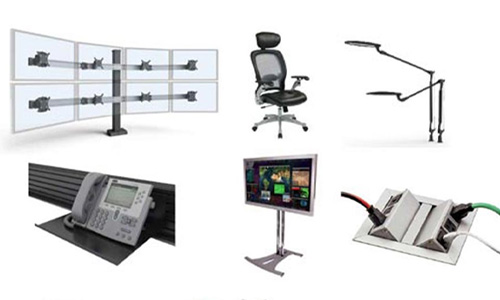
- Monitor mounting systems with precise ergonomic adjustability
- Organized cable management that preserves airflow and security
- Service access panels allowing maintenance without full disassembly
- Documentation supporting security accreditation reviews
This checklist helps prevent costly retrofits or furniture replacement during accreditation.
Thermal Management in Sealed, Secure Spaces
SCIF control rooms often face elevated heat loads due to dense technology deployments combined with restricted airflow from shielding and security barriers.
Console furniture plays a key role in thermal performance by:
- Maintaining airflow clearances around equipment
- Using perforated panels and strategic ventilation
- Supporting supplemental or localized cooling solutions
- Reducing heat buildup in enclosed equipment bays
Poor thermal design can shorten equipment lifespan and compromise mission readiness.
Ergonomics and Operator Performance in SCIF Environments
Security requirements should never force operators to work under compromised conditions. Extended shifts demand:
- Proper monitor height, distance, and viewing angles
- Adjustable work surface heights
- Adequate leg clearance and posture support
- Stable, low-glare lighting conditions
Ergonomic failures degrade situational awareness, increase fatigue, and raise error rates—risks that undermine mission objectives regardless of security posture.
SCIF Accreditation and Planning Considerations
Before an SCIF control room becomes operational, it must undergo a rigorous accreditation process to verify compliance with all security requirements.
Best practices include:
- Engaging security specialists during initial concept design
- Coordinating infrastructure, furniture, and layout decisions early
- Selecting vendors experienced with classified environments
- Phasing implementation and testing before full deployment
Attempting to retrofit security into completed designs often results in delays and unnecessary expense.
Future Trends in SCIF Control Room Design
Emerging trends include:
- Modular and rapidly deployable SCIF environments
- Increased automation and security monitoring integration
- Greater focus on energy efficiency within security constraints
- Console systems designed specifically for classified operations
Organizations that plan with flexibility and scalability in mind will be better positioned to adapt as mission requirements evolve.
Conclusion: Integrating Security and Performance
Successful SCIF control room design requires more than meeting security standards. It demands environments where security and human performance reinforce one another, enabling operators to work effectively under pressure without compromising classified information.
By integrating console furniture selection, infrastructure planning, ergonomics, and accreditation requirements from the outset, organizations can create secure command environments that support long-term operational excellence.
For assistance with SCIF-ready control room design, console furniture, or related accessories, contact Command Watch at 800-346-7521 or cwsales@command-watch.com.
You May Also Like:
Guide to Choosing 24/7 Mission-Critical Consoles
This resource outlines what to prioritize when evaluating console furniture for demanding real-time operations.